Britain still has the widest choice of right-hand-drive cars: more estates, more trims and more of the unusual specifications that rarely reach the market here. What changed with Brexit is the bill between a British forecourt and an Irish plate. A car bought in England, Scotland or Wales now goes through customs, and customs duty plus 23 percent import VAT are added before VRT is even calculated.
The bill is followed line by line below, using a real Autotrader advert checked on 18 September 2026 and a live Importcalc calculation. The 2021 BMW 330e M Sport Touring below is advertised at £19,986 and lands at about €35,160 on Irish plates, which is more than comparable cars already cost here. For a specification you cannot find here it can still be the right buy; on price alone it rarely is.
Northern Ireland is a separate route with its own rules, so "the UK" in this article means Great Britain.
What Revenue requires on a car from Great Britain
For customs purposes Great Britain has been outside the EU since 1 January 2021. Revenue's guidance, published on 24 August 2026, sets out three steps that must be finished before the car can be registered:
Complete a customs declaration.
Pay customs duty, where it applies.
Pay VAT on the import value of the car.
The same steps apply when the car travels through Northern Ireland on its way here. At the NCTS centre you then need the V5C, a copy of the customs declaration showing its Master Reference Number (MRN) and any supporting documents, all clearly identifying that specific car. VRT and the NOx levy are paid at registration.
Where a customs declaration is required, the car is liable to seizure if the declaration is not completed or the car is not registered within 30 days of arriving in the State. The NCTS appointment itself has to be made within seven days of arrival.
How duty and VAT stack
The customs value is the euro price of the car plus transport and insurance to the point of entry. The standard EU customs duty on a passenger car is 10 percent of that value. Import VAT at 23 percent is then charged on the customs value plus the duty. Together the two add just over 35 percent to whatever the car and its freight cost you.
VRT sits outside that stack. It is a percentage of Revenue's Irish Open Market Selling Price (OMSP), set by the car's CO2 band, with the NOx levy on top. A cheap British purchase lowers the duty and the VAT. It does nothing to the VRT.
Customs origin: when duty can be zero
Under the trade agreement between the EU and the UK, duty is eliminated only for goods that meet the origin rules. Here that means a car of UK origin, and Revenue expects proof: a statement on origin from the exporter, or supporting records in the importer's possession. A British registration, a British seller or years on British roads say nothing about where the car was made. A BMW built in Germany stays a German-origin car. Revenue also lists Returned Goods Relief as a route to zero duty in certain circumstances.
Importcalc handles this in the cost details. You pick the country the car was manufactured in and the planned declaration date. The standard 10 percent rate is the default and recalculates as you add shipping and insurance. If the car was manufactured in the United Kingdom, a second option appears: 0 percent preferential origin, on the condition that you will hold valid proof. A third option lets you enter the exact amount from a customs declaration or a broker's quote, including a documented zero.
The worked example: a real advert
The example is an Autotrader UK advert from the dealer Carsa, opened and checked on 18 September 2026 (advert 202609095870733):
2021 (21 reg) BMW 330e M Sport Touring, petrol plug-in hybrid, automatic, white
43,498 miles, about 70,000 km
£19,986 including the dealer's admin fee, flagged by Autotrader as £1,117 below market average
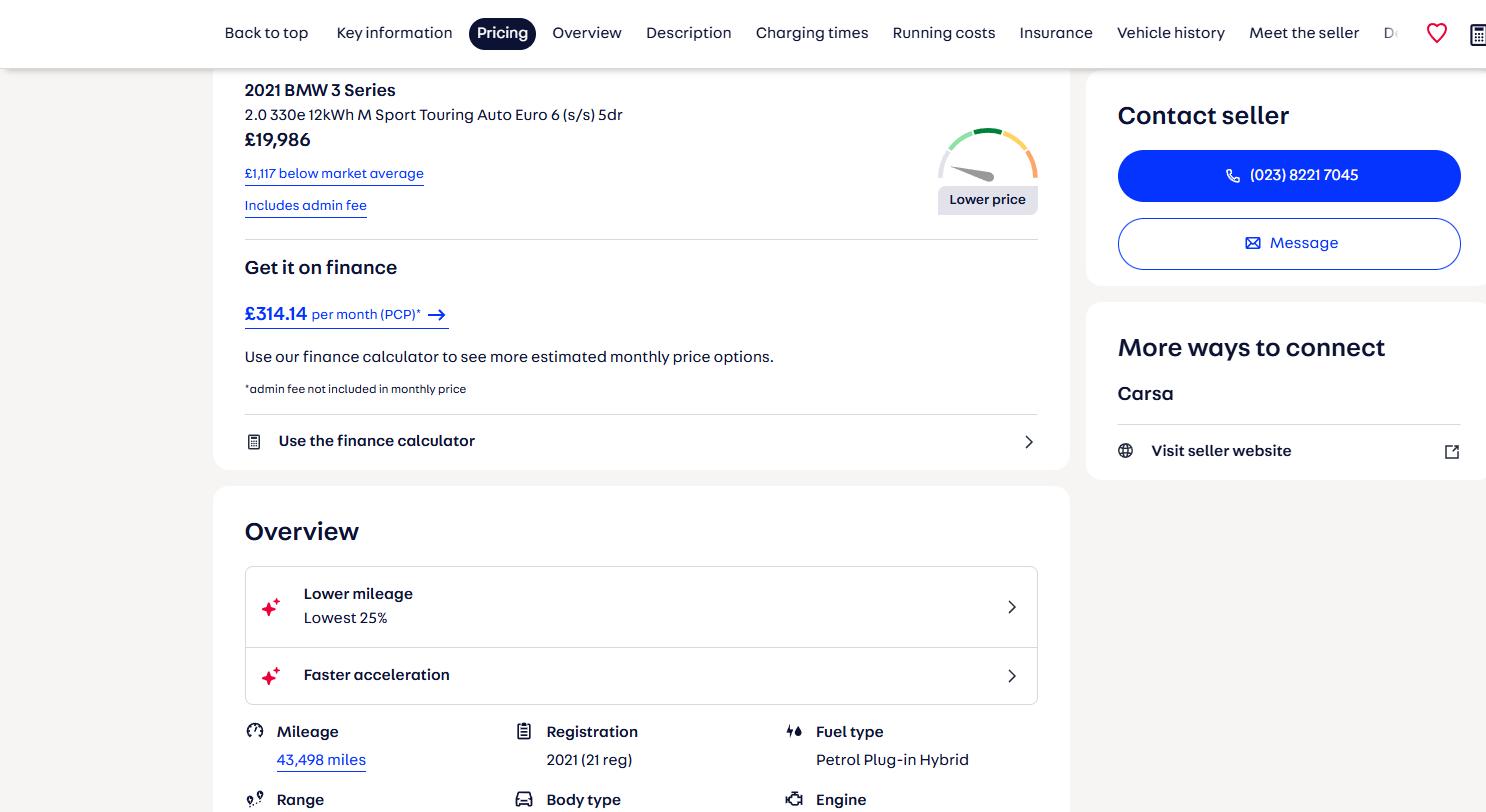
Two assumptions go with it. The advert gives the plate period and not the exact day, so the calculation uses 1 June 2021, inside the 21-plate window of March to August 2021; the V5C settles the real date. Transport is entered as €900 for the ferry crossing and delivery, to be replaced with a written quote.
The same Autotrader search returned 73 BMW 330e estates from 2021 and 2022 with under 60,000 miles. On the same day DoneDeal showed fewer than a dozen in Ireland. That depth of choice is the reason to look across the water at all.
How Importcalc prices it
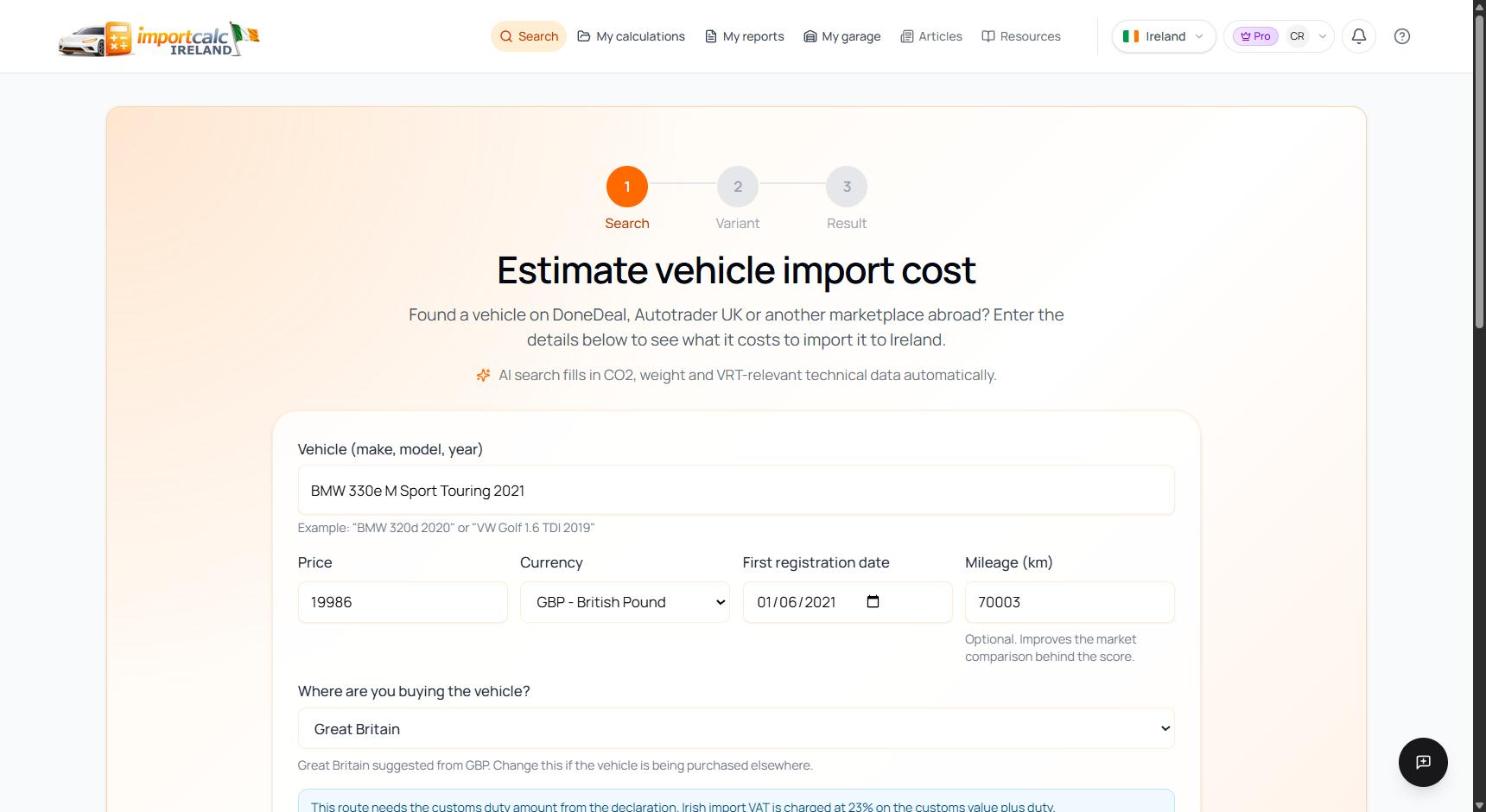
You enter the car, the asking price in pounds, the first registration date, the mileage and where you are buying. Choosing pounds sterling suggests Great Britain as the purchase origin, and the form notes that this route needs the customs duty amount from the declaration and that Irish import VAT is charged at 23 percent on the customs value plus duty.
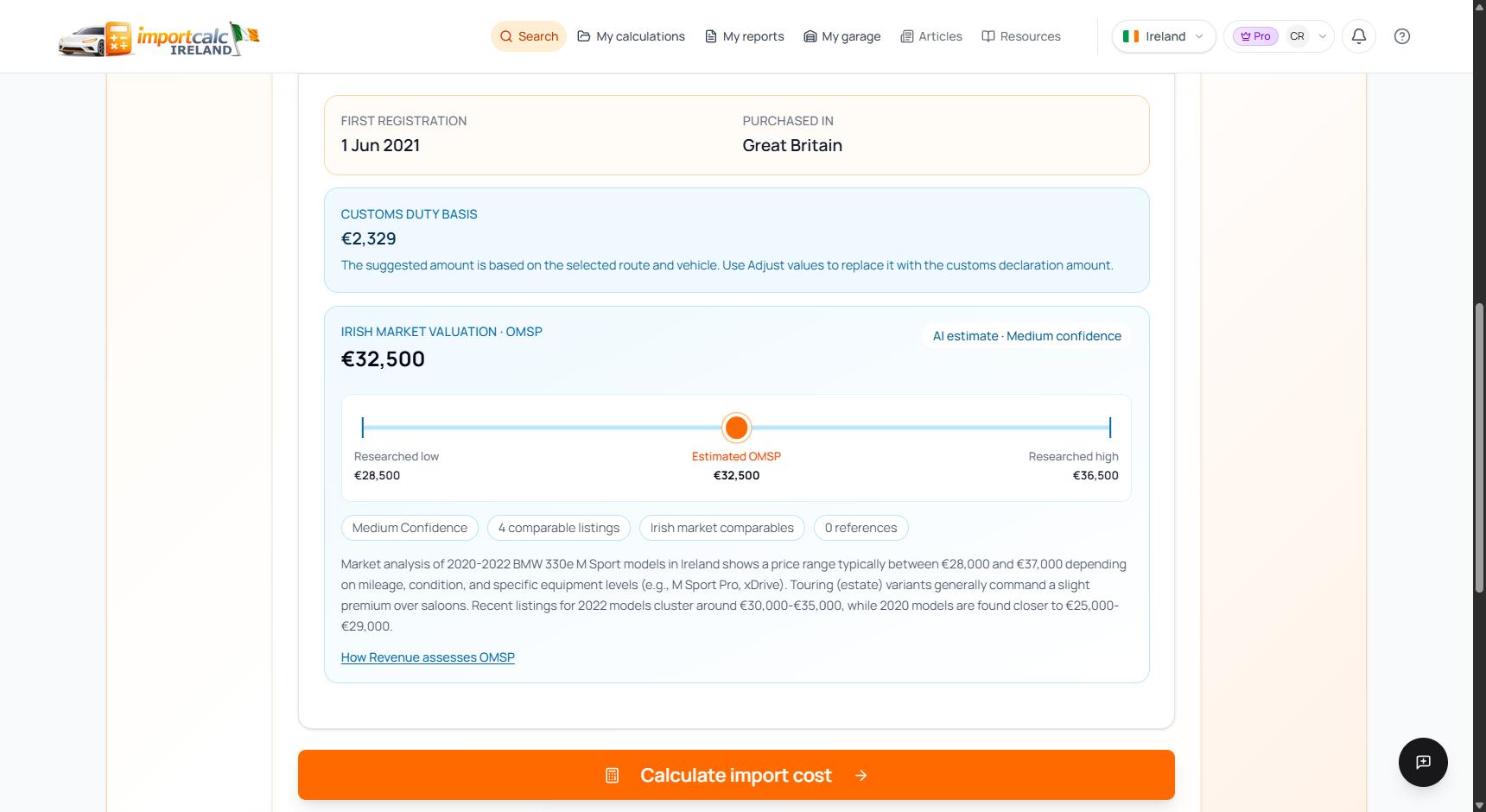
The AI search then returns the technical data and a valuation. For this car it recognised 38 g/km CO2 (WLTP), 25 mg/km NOx, 1,970 kg and 215 kW, all marked as AI estimates to confirm against the V5C and the Certificate of Conformity. It suggested €2,329 of customs duty on the car alone and researched an OMSP of €32,500 with medium confidence, inside a range of €28,500 to €36,500. That figure was kept, because the adverts further down bracket it.
After the calculation you add shipping and insurance, and the duty and VAT recalculate. The exchange rate used was 1 GBP = 1.1653 EUR, dated 11 September 2026 by the calculator.
The numbers
Line | Amount |
|---|
Advertised price | £19,986 |
At 1 GBP = 1.1653 EUR (rate of 11 September 2026) | €23,290 |
Transport (assumption) | €900 |
Customs value | €24,190 |
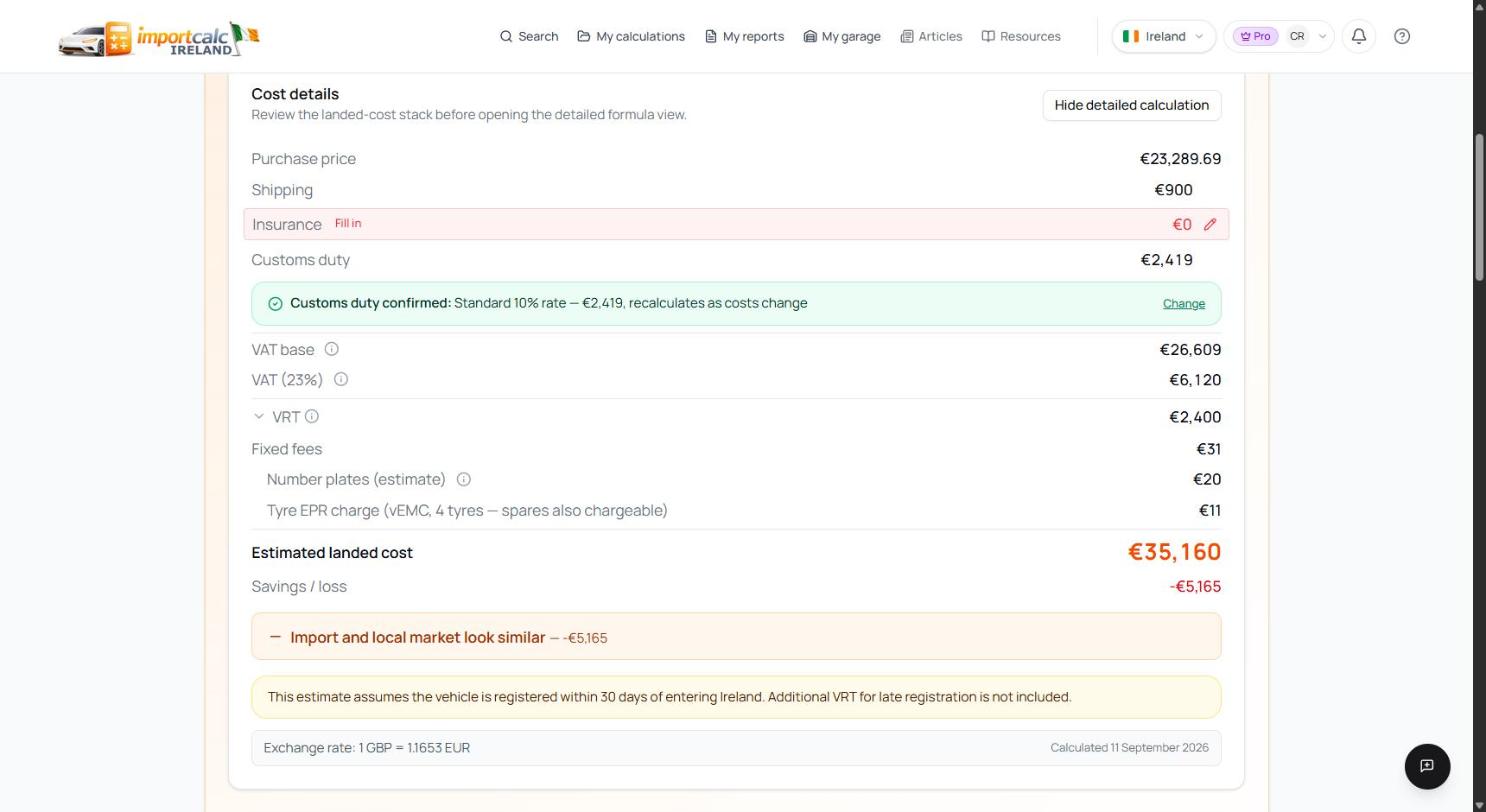
Customs duty at the standard 10 percent | €2,419 |
Import VAT at 23 percent on €26,609 | €6,120 |
VRT (7 percent of €32,500 OMSP) | €2,275 |
NOx levy (25 mg/km at €5) | €125 |
Plates and tyre charge | €31 |
Total, landed and registered | €35,160 |
Duty and VAT come to €8,539, more than a third of what the car and its freight cost. VRT is the small line here because a plug-in hybrid under 50 g/km sits in the lowest band. Transport insurance and an inspection are not in the total.
The zero-duty case, and why it does not apply here
To show what origin is worth, the same calculation was switched to United Kingdom manufacture with the 0 percent preferential option. Duty falls to €0, the VAT base drops to €24,190 and import VAT to €5,564. The landed total becomes €32,185, which is €2,975 lower. Import VAT does not go away.
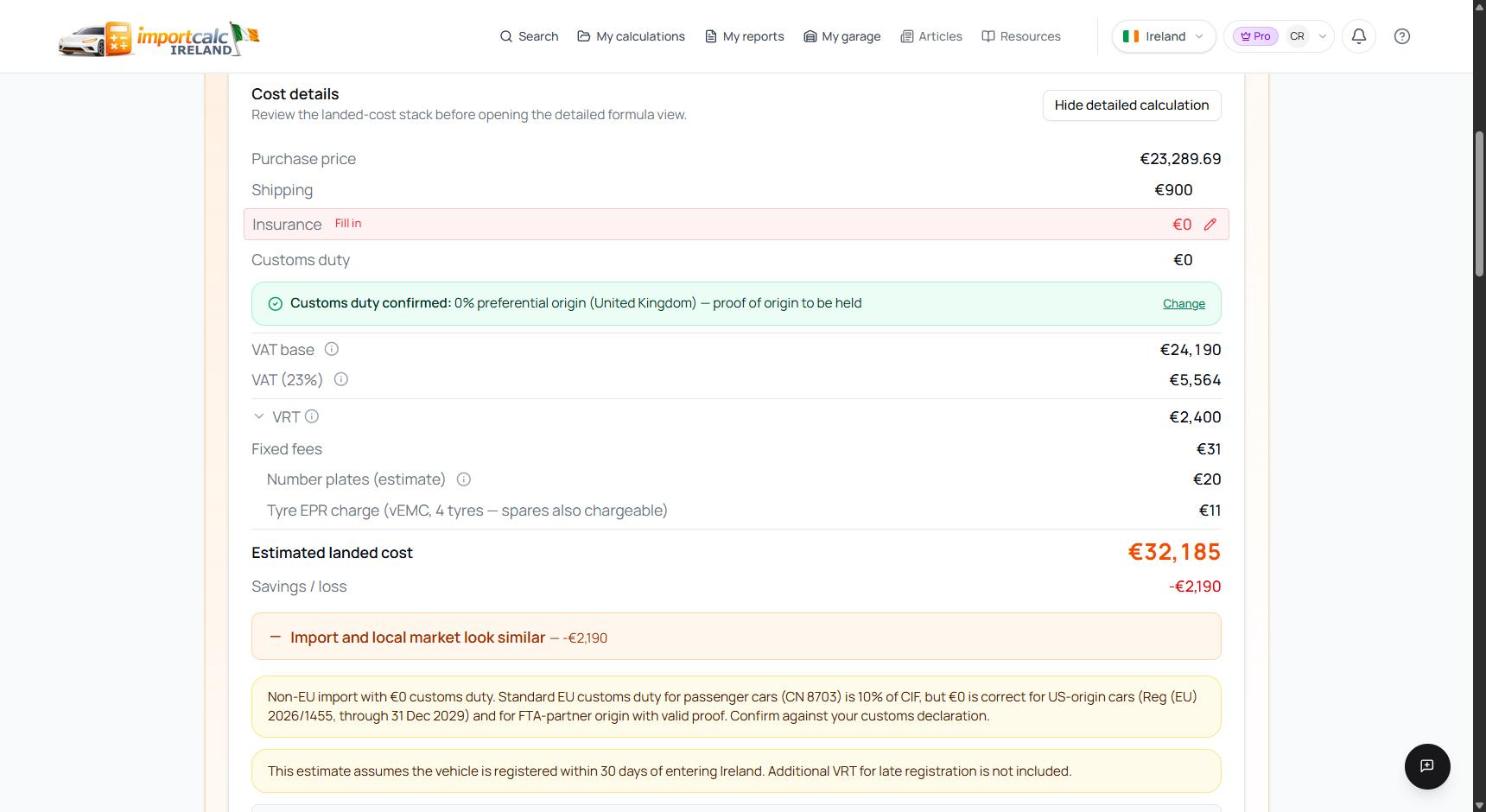
This BMW was built in Germany, so the zero-duty figure is not available to it and the calculation was set back to the standard rate. The comparison matters for cars that were assembled in Britain, and only with proof of origin in hand. Importcalc's own note on a zero-duty result says the same: confirm it against the customs declaration.
How it compares with cars already here
On 18 September 2026 DoneDeal listed these BMW 330e estates from 2021 to 2023:
Car | Year | Mileage | Asking price |
|---|
330e SE Pro estate, Wicklow | 2021 | 75,288 km | €29,995 |
330e M Sport estate, Dublin 12 | 2023 | 73,721 km | €36,450 |
330e xDrive M Sport Touring, Galway | 2022 | 47,252 km | €39,950 |
330e M Sport Pro Touring, Dublin | 2022 | 148,059 km | €31,995 |
330e M Sport estate, Kildare | 2022 | 129,261 km | €29,950 |
The landed €35,160 sits in the upper half of that band. The closest car on age and mileage is the 2021 SE Pro in Wicklow at €29,995, sold by a dealer with a one-year warranty. It is €5,165 cheaper than the import, in a lower trim than the M Sport. The 2023 M Sport in Dublin is two years newer at €36,450. A 2022 Sport Pro Touring with 71,598 km that was advertised at €34,950 in early September is now marked as sold. None of these is a strict match on year, trim and mileage, so there is no savings percentage to quote, and on these numbers there is no saving: Importcalc scores the case 23 out of 100.
The Wicklow and Dublin 12 adverts were opened and checked on their own pages. The other three rows come from the same day's search results; those adverts were not opened and are not confirmed as live.
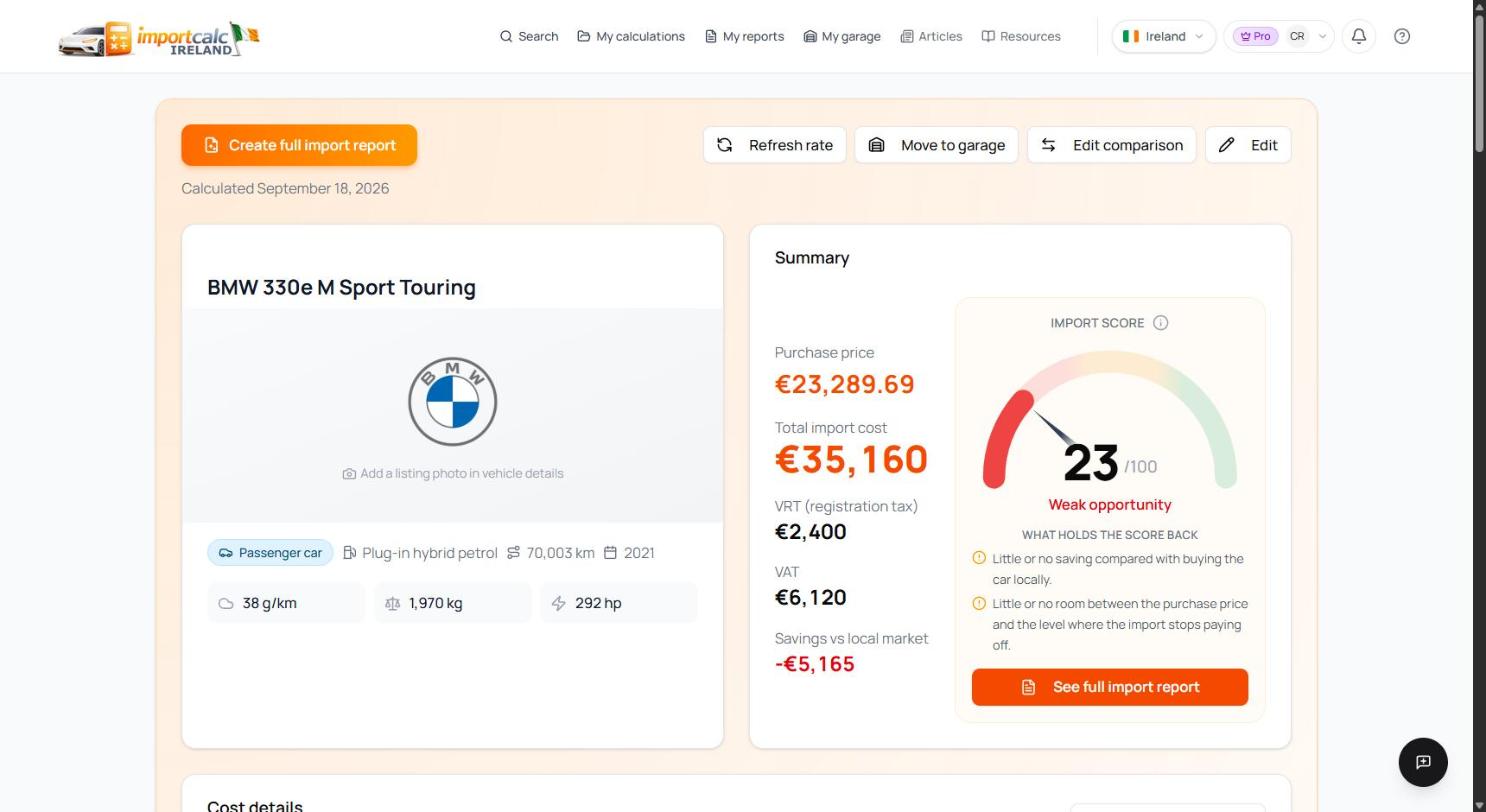
What the British car offers is the specification: an M Sport Touring with about 70,000 km, from a market with 73 to choose from. If that exact car is what you want and stock here does not have it, the calculation tells you what the choice costs. If any 330e estate will do, the better buy is already here.
What moves the result
The exchange rate. A weaker euro raises the purchase price, and duty and VAT compound on top of it.
Transport and insurance. Both enter the customs value, so both raise duty and VAT.
The OMSP. Revenue sets it at registration. A higher valuation raises VRT at 7 percent on this car and at a far higher rate on a car with high CO2.
The documents. Official CO2 and NOx figures replace the AI estimates, and a missing NOx figure brings Revenue's default charge of €4,850 on a diesel and €600 on other cars.
Origin. A documented UK-origin claim removes the duty line, as the zero-duty case shows.
Documents to secure before the car moves
The full original V5C, with the exact first registration date.
A purchase invoice with the seller, the buyer, the VIN, the price and the date.
The Certificate of Conformity or other official evidence of CO2, NOx and the test method.
A statement on origin or other proof, if a preferential duty rate is claimed.
Written transport and insurance quotes, then the invoices.
Service history, finance clearance and warranty terms.
The order of work
Run the estimate with the standard duty rate before paying a deposit, and check it against Irish adverts.
Collect the documents above and ask a customs agent what will appear on the declaration.
Complete the customs declaration, pay the duty and the import VAT, and keep the MRN.
Keep proof of the date the car entered the State, such as the ferry booking.
Make the NCTS appointment within seven days of arrival.
Register the car and pay VRT within 30 days. Revenue charges additional VRT for late registration.
Fit the plates, then arrange motor tax and insurance.
Frequently asked questions
How much customs duty is there on a car from the UK?
The standard rate for passenger cars is 10 percent of the customs value, which is the price plus transport and insurance, where no preference or relief applies. The amount on your customs declaration is the one that counts.
Is import VAT charged on the purchase price only?
No. It is 23 percent of the customs value plus the customs duty, so transport, insurance and duty all raise the VAT.
Does a UK registration prove UK origin?
No. Origin is about where the car was made and whether the origin rules of the trade agreement are met. It has to be proven with a statement on origin or supporting records.
Does zero duty also remove import VAT?
No. In the example the zero-duty case still carries €5,564 of import VAT.
Do the same rules apply to a car from Northern Ireland?
No. A used car bought in Northern Ireland can be registered without customs duty and import VAT if it was legally imported into Northern Ireland and you can prove it. A car that only travels through Northern Ireland from Great Britain is treated as a Great Britain import.
This market snapshot was checked on 18 September 2026. The British advert and the Irish adverts in Wicklow and Dublin 12 were opened and live on that date; used-car adverts can change or disappear. The other Irish rows come from same-day DoneDeal search results whose listing pages were not opened, so they are market context only and no savings claim rests on them. The calculation was run live on importcalc.com the same day. Revenue's guidance was checked on 18 September 2026. Revenue determines the final OMSP, classification and tax at registration.