For a passenger car, Vehicle Registration Tax is a percentage of what Revenue says the car is worth here, not of what you paid for it abroad. The percentage comes from the car's CO2 figure. A separate NOx levy is added on top, and a relief can take an electric car to zero.
Each input is explained below and shown working in three live Importcalc calculations from September 2026: a plug-in hybrid Mercedes GLE in the lowest band, a petrol BMW 330i where the CO2 figure alone moves the bill by €1,575, and an electric Volkswagen ID.4 whose VRT is cancelled by the relief.
The formula
Most imported cars are VRT category A: passenger cars, generally European category M1. For these, Revenue calculates:
a CO2 charge: the rate for the car's CO2 band, multiplied by the Open Market Selling Price (OMSP), with a minimum amount per band
plus a NOx levy based on the car's NOx emissions in mg/km
less the relief for battery-electric cars, where it applies.
Customs duty and VAT are separate questions that depend on where the car comes from. They are covered at the end.
OMSP is the Irish value
The OMSP is Revenue's valuation of the car on the Irish market, and Revenue notes that it is usually slightly different from the invoice value. It is set at registration, so until then any figure is a planning input.
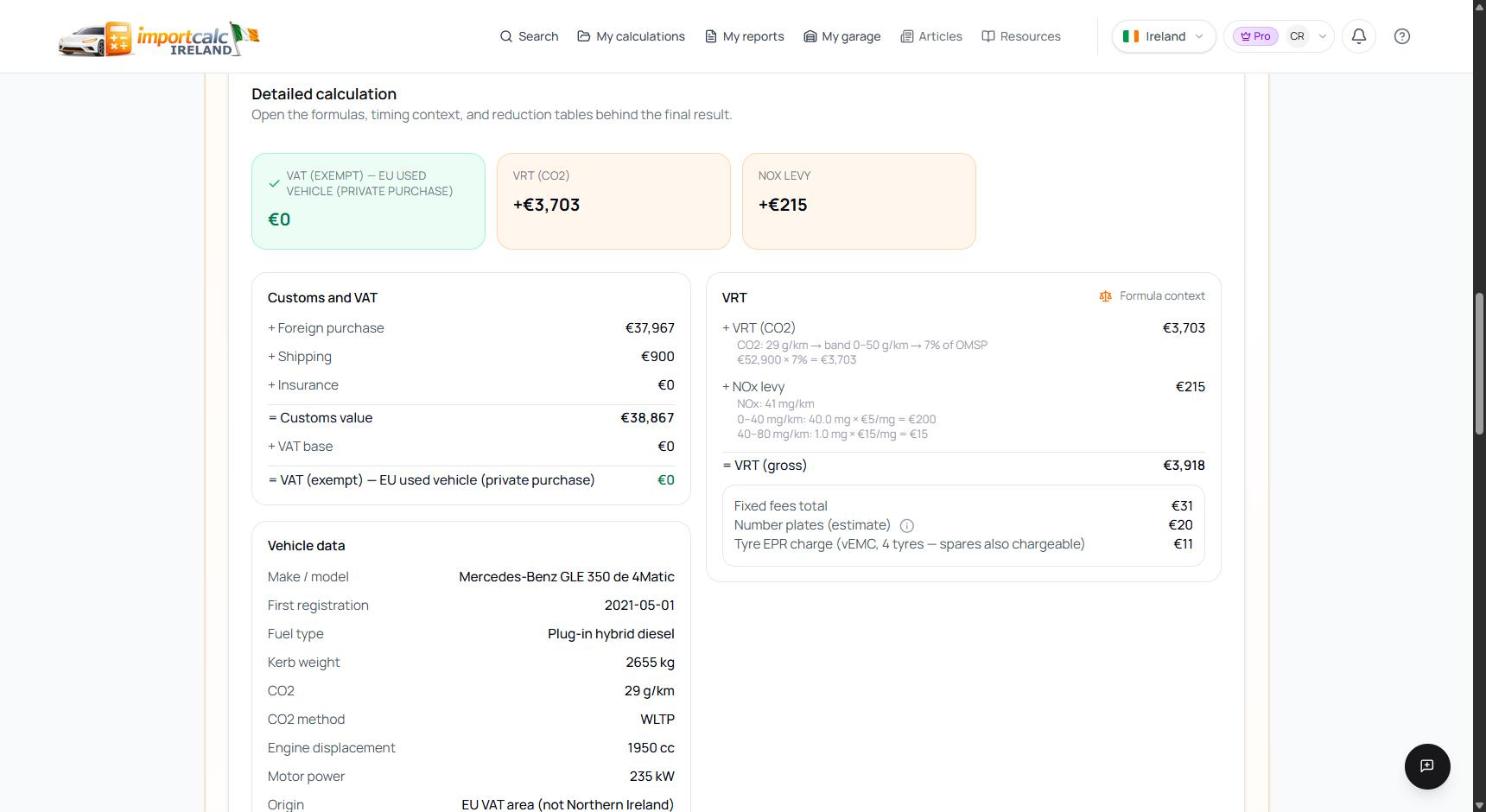
The Mercedes, a 2021 GLE 350 de, was advertised in Germany at €37,967. The OMSP used in the calculation is €52,900, the asking price of the closest Irish advert, and VRT is 7 percent of that figure: €3,703. The German price only matters for the landed total.
Importcalc researches an OMSP for each car, shows the low and high of its range and the confidence, and lets you replace the figure with your own before calculating. For the GLE its research proposed €58,000. Against dated adverts here that was high for a car with 131,852 km, so the lower documented figure was entered instead.
The 20 CO2 bands
These rates have applied since 1 January 2022. Revenue charges the percentage or the minimum, whichever is greater.
CO2 emissions | VRT as a share of OMSP | Minimum VRT |
|---|
0 to 50 g/km | 7% | €140 |
More than 50 to 80 g/km | 9% | €180 |
More than 80 to 85 g/km | 9.75% | €195 |
More than 85 to 90 g/km | 10.5% | €210 |
More than 90 to 95 g/km | 11.25% | €225 |
More than 95 to 100 g/km | 12% | €240 |
More than 100 to 105 g/km | 12.75% | €255 |
More than 105 to 110 g/km | 13.5% | €270 |
More than 110 to 115 g/km | 15.25% | €305 |
More than 115 to 120 g/km | 16% | €320 |
More than 120 to 125 g/km | 16.75% | €335 |
More than 125 to 130 g/km | 17.5% | €350 |
More than 130 to 135 g/km | 19.25% | €385 |
More than 135 to 140 g/km | 20% | €400 |
More than 140 to 145 g/km | 21.5% | €430 |
More than 145 to 150 g/km | 25% | €500 |
More than 150 to 155 g/km | 27.5% | €550 |
More than 155 to 170 g/km | 30% | €600 |
More than 170 to 190 g/km | 35% | €700 |
More than 190 g/km | 41% | €820 |
The bands are hard edges. One gram can move a car from 21.5 percent to 25 percent, and the new rate applies to the whole OMSP.
One car, three CO2 figures
A BMW 330i on sale in Germany shows how much the CO2 figure is worth. The advert is from Automobile Osterfeld in Gelsenkirchen: a 330i saloon first registered 10/2021 with 63,500 km at €29,499. It was first opened on 3 September 2026 and was still live on 18 September 2026. The advert itself lists 129 g/km.
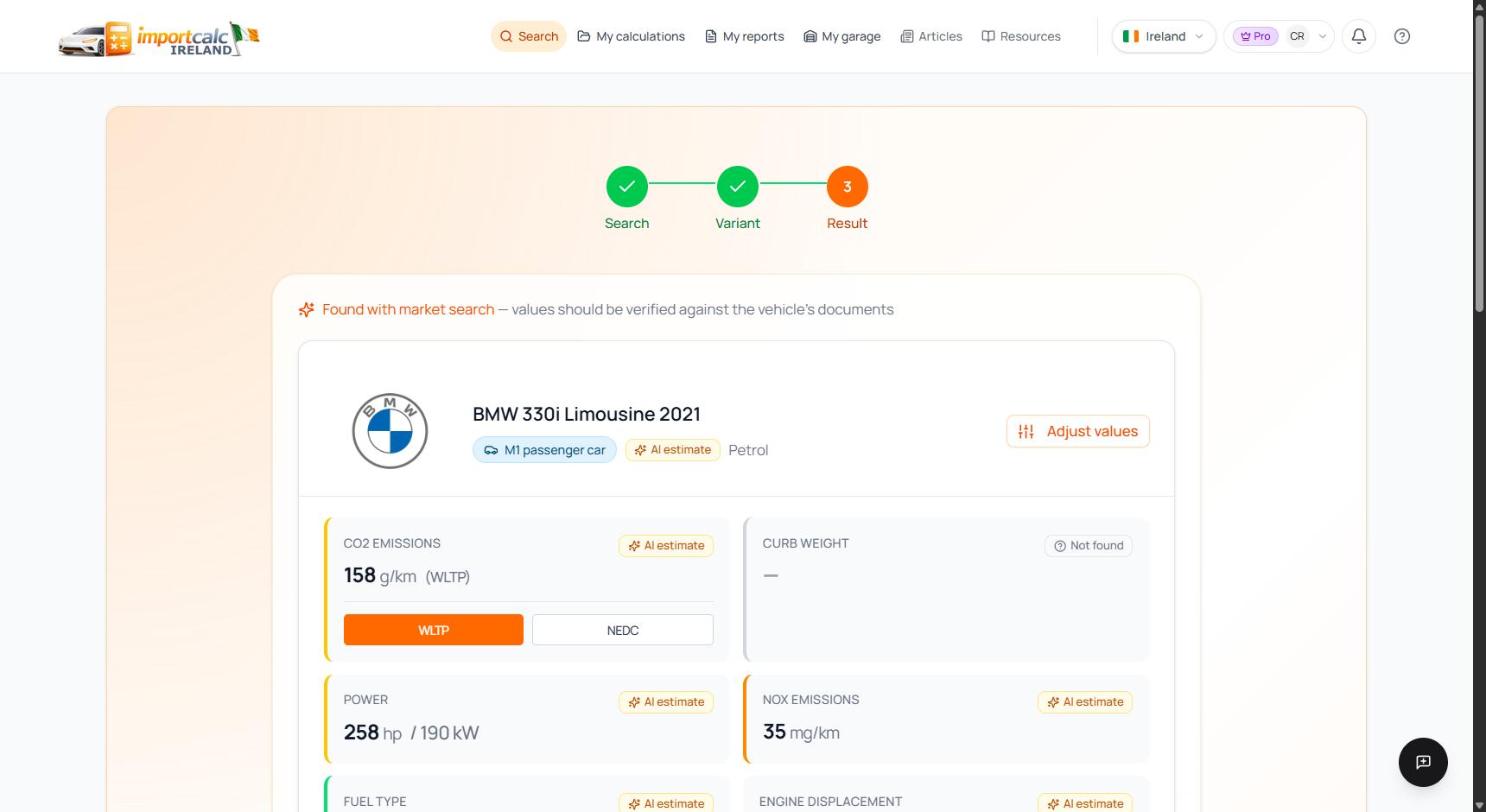
Importcalc's AI search returned 158 g/km WLTP and 35 mg/km NOx for this car, marked as AI estimates to confirm against the documents, and researched an OMSP of €31,500 with medium confidence, inside a range of €28,500 to €34,500.
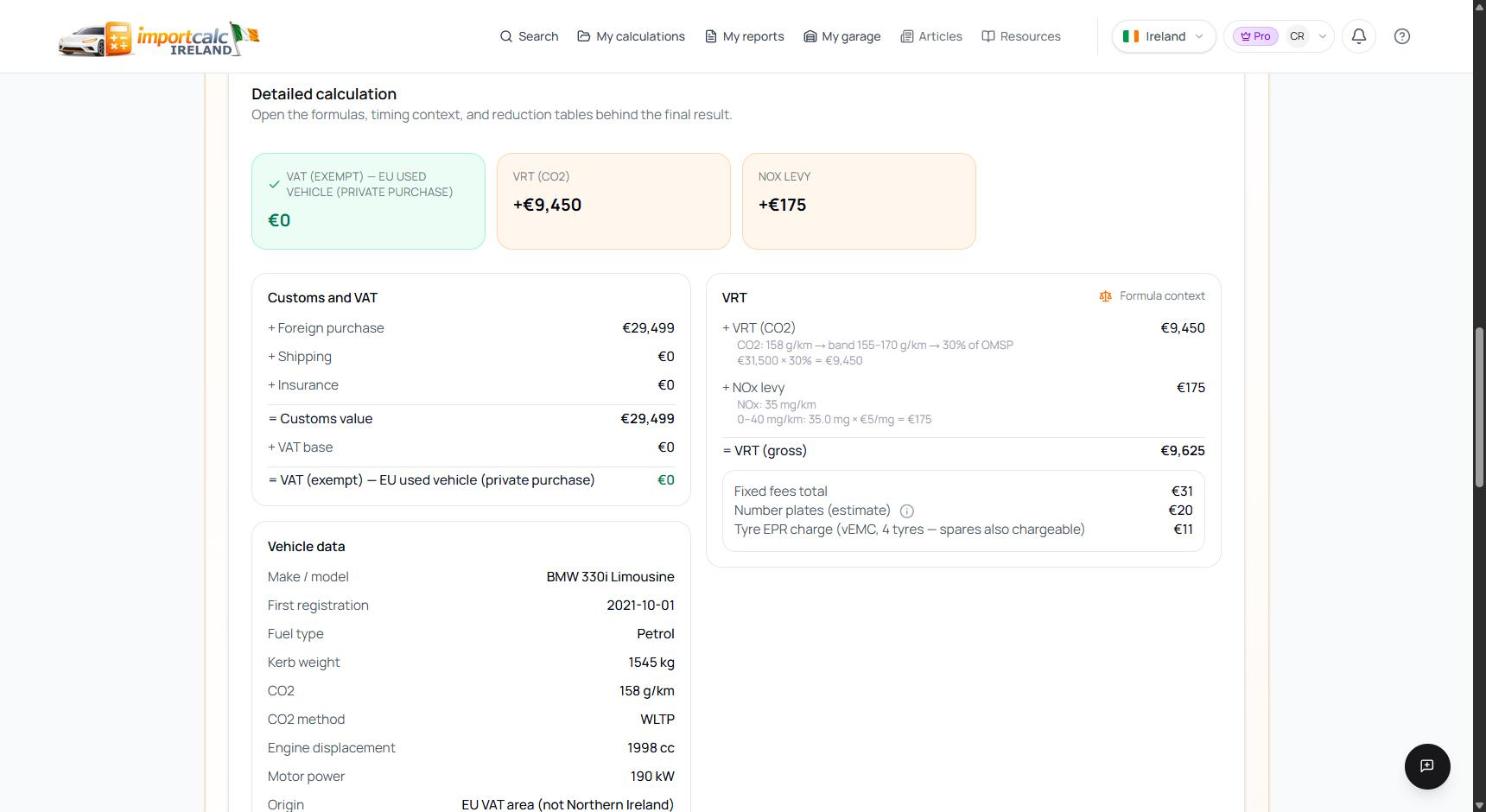
At 158 g/km the car sits in the band from 155 to 170 g/km, and VRT is 30 percent of OMSP.
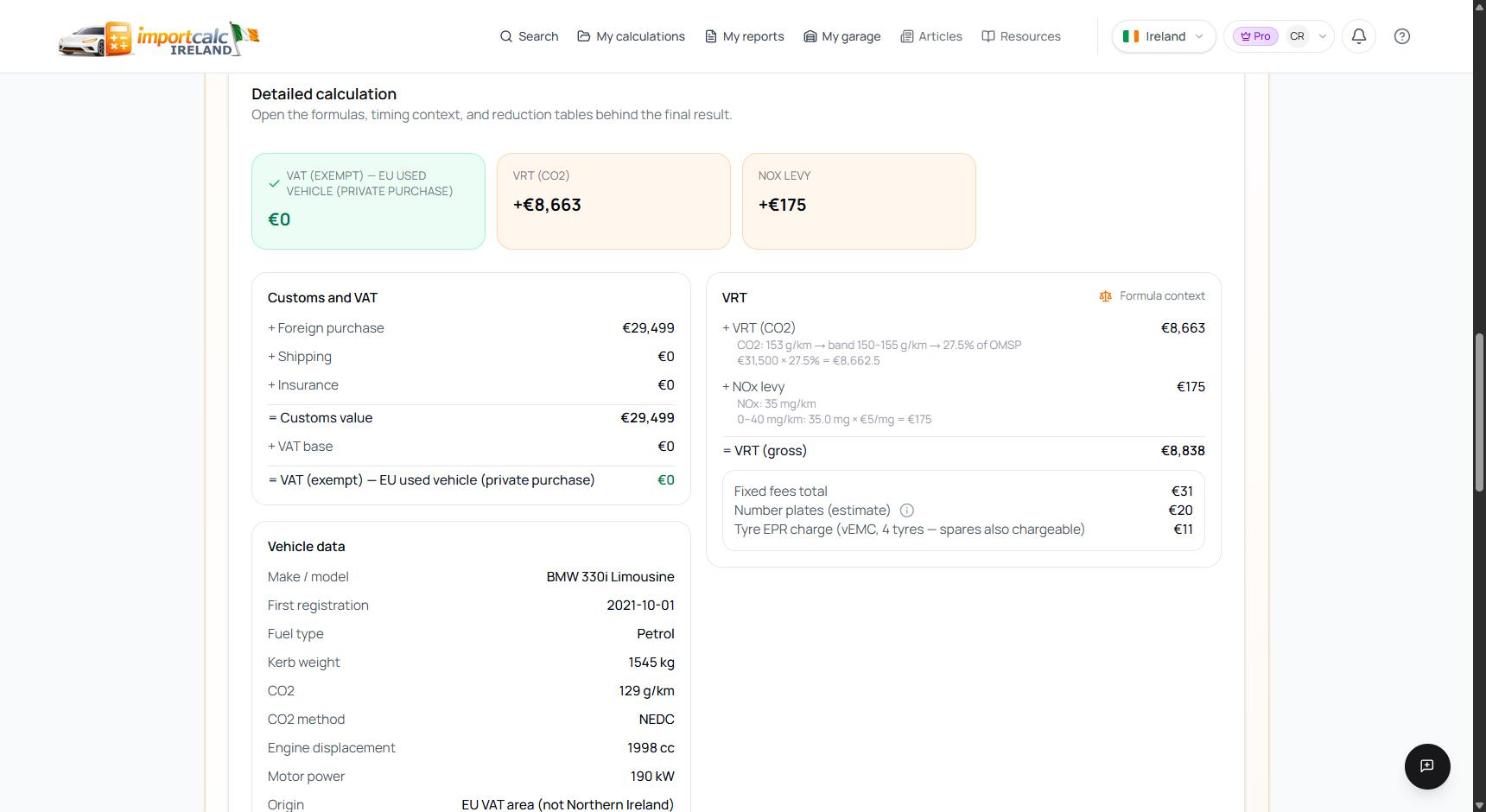
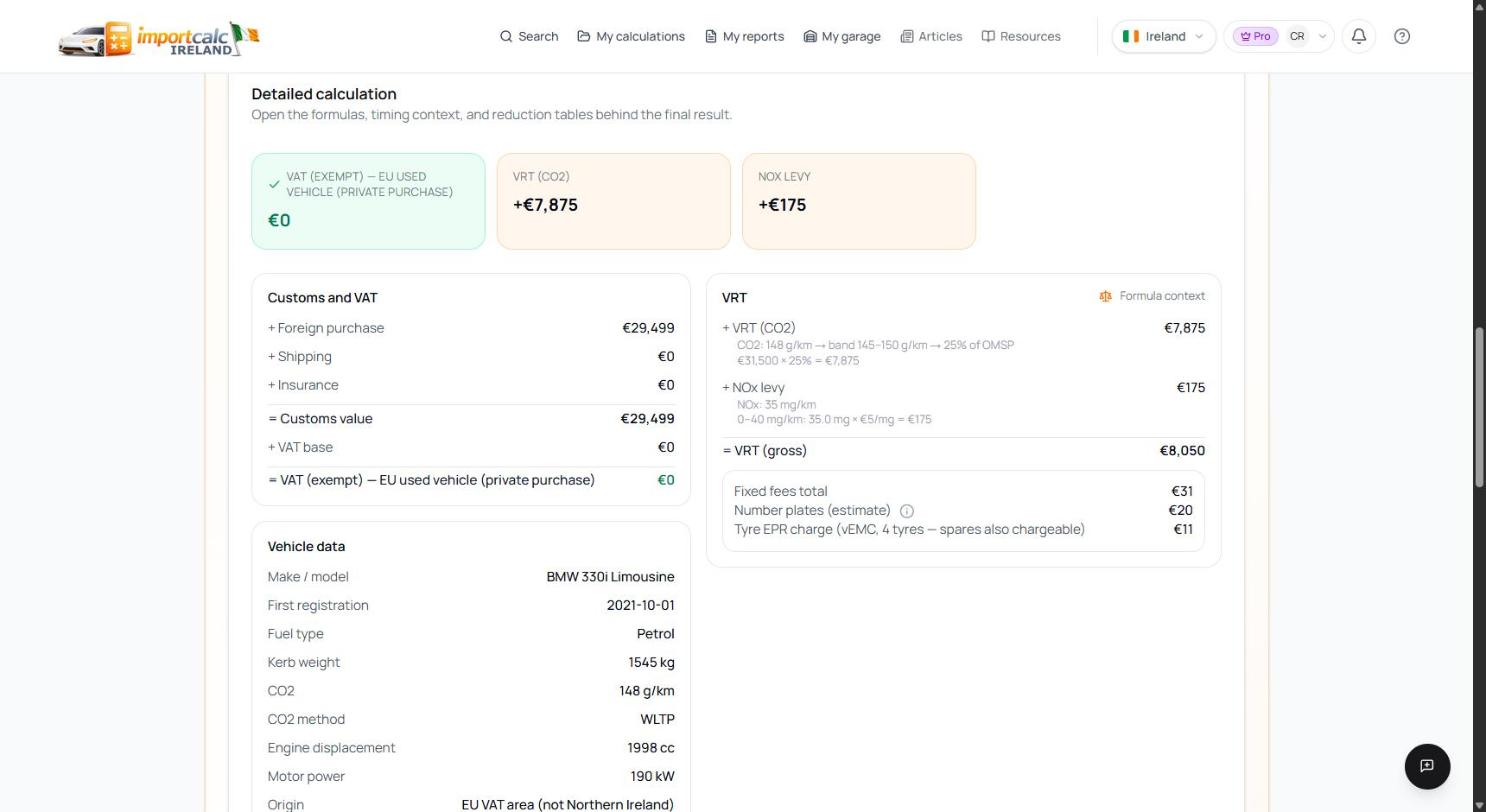
The same calculation was then re-run with two other figures. A search for the same car on the Dutch version of Importcalc had returned 148 g/km WLTP, which falls in the 25 percent band. And if the only documented figure turned out to be the advert's 129 g/km on the older NEDC test, Revenue's conversion formula applies first. Importcalc does that conversion when NEDC is selected: 129 g/km becomes 153 g/km, in the 27.5 percent band.
CO2 figure entered | Band and rate | CO2 charge | VRT with NOx | Landed before transport |
|---|
158 g/km WLTP (AI estimate) | 155 to 170 g/km, 30% | €9,450 | €9,625 | €39,155 |
148 g/km WLTP | 145 to 150 g/km, 25% | €7,875 | €8,050 | €37,580 |
129 g/km NEDC, converted to 153 g/km | 150 to 155 g/km, 27.5% | €8,663 | €8,838 | €38,368 |
Nothing else changed, and there is €1,575 between the highest and lowest VRT. None of these three figures is the official one. That is on the Certificate of Conformity and the registration document, and it is worth asking the seller for both before you negotiate.
WLTP and NEDC
Revenue uses the WLTP figure for cars that were previously registered with WLTP data. For a used car that was registered on an NEDC figure, it first calculates a CO2 figure with these formulas and then assigns the band:
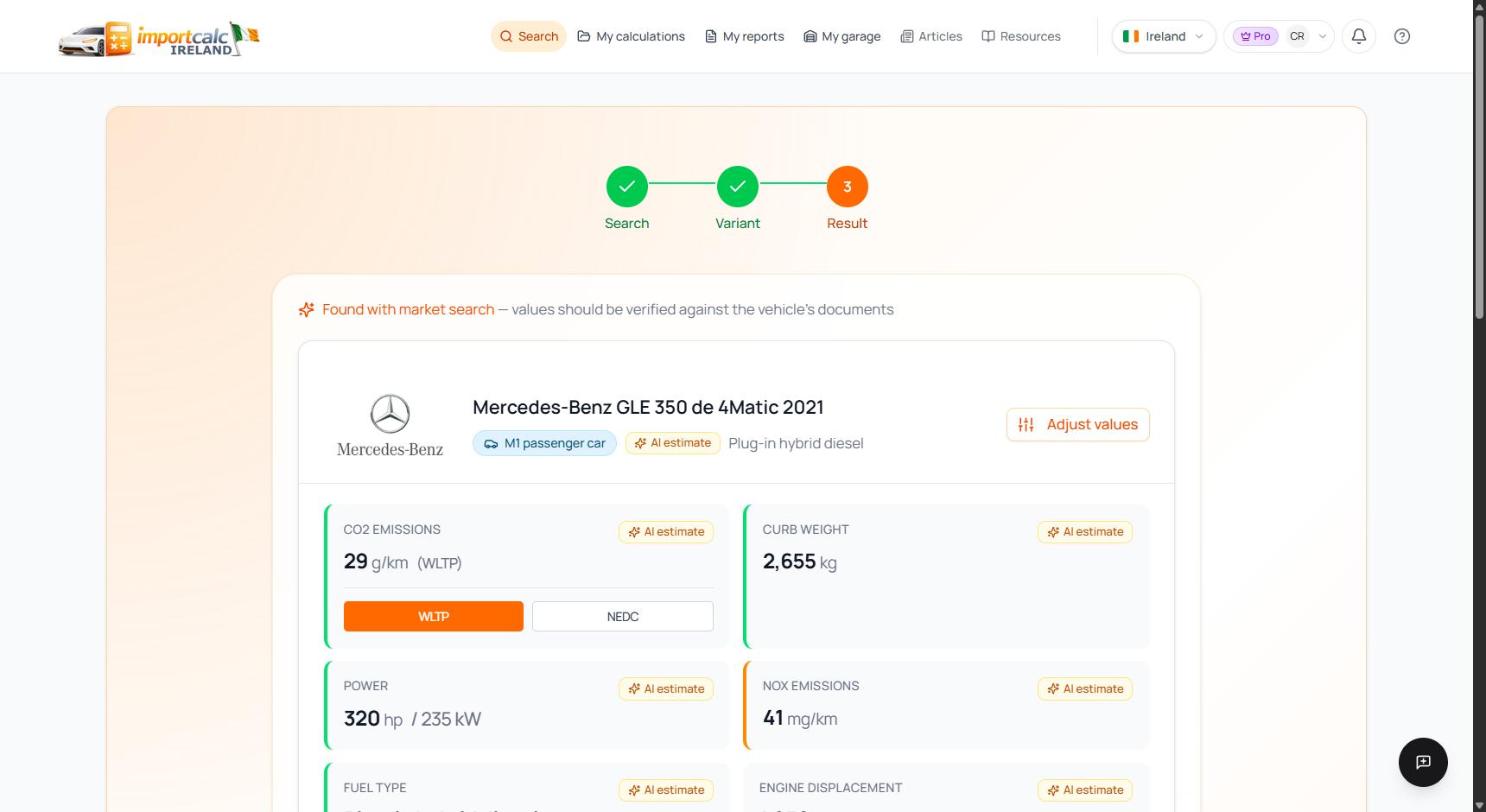
An NEDC figure typed into a WLTP field puts the car in a band that is too low. In Importcalc the test method is a switch beside the CO2 figure on the data step, and an AI estimate can arrive with either setting. On the Mercedes above the 29 g/km arrived flagged as NEDC and was switched to WLTP, the basis a 2021 car is registered on. Check it against the documents.
The NOx levy
Category A petrol, diesel, hybrid and plug-in hybrid cars pay a NOx levy on the official NOx figure in mg/km. It is charged in steps:
NOx emissions | Charge per mg/km |
|---|
The first 40 mg/km | €5 |
The next 40 mg/km, up to 80 mg/km | €15 |
Above 80 mg/km | €25 |
The Mercedes has 41 mg/km, so it pays €200 for the first 40 and €15 for the one milligram above: €215. The BMW pays €175 on 35 mg/km. Electric cars pay no NOx levy.
If you cannot present satisfactory evidence of the NOx figure, Revenue charges a default: €4,850 for a diesel and €600 for other vehicles. On a diesel plug-in like the GLE that is the difference between €215 and €4,850. The Certificate of Conformity is accepted evidence, so secure it before the registration appointment.
Electric cars: relief until the end of 2026
Series-production battery-electric cars registered before 31 December 2026 get relief from VRT of up to €5,000. The full relief applies up to an OMSP of €40,000, a reduced relief applies between €40,000 and €50,000, and there is none above €50,000.
The live example is a 2021 Volkswagen ID.4 Pro Performance 77kWh 1ST Edition advertised by a dealer in Newry at £18,595, opened and checked on 18 September 2026. Importcalc researched an OMSP of €21,500 with medium confidence. The gross VRT is 7 percent of that, €1,505, and the relief removes all of it.
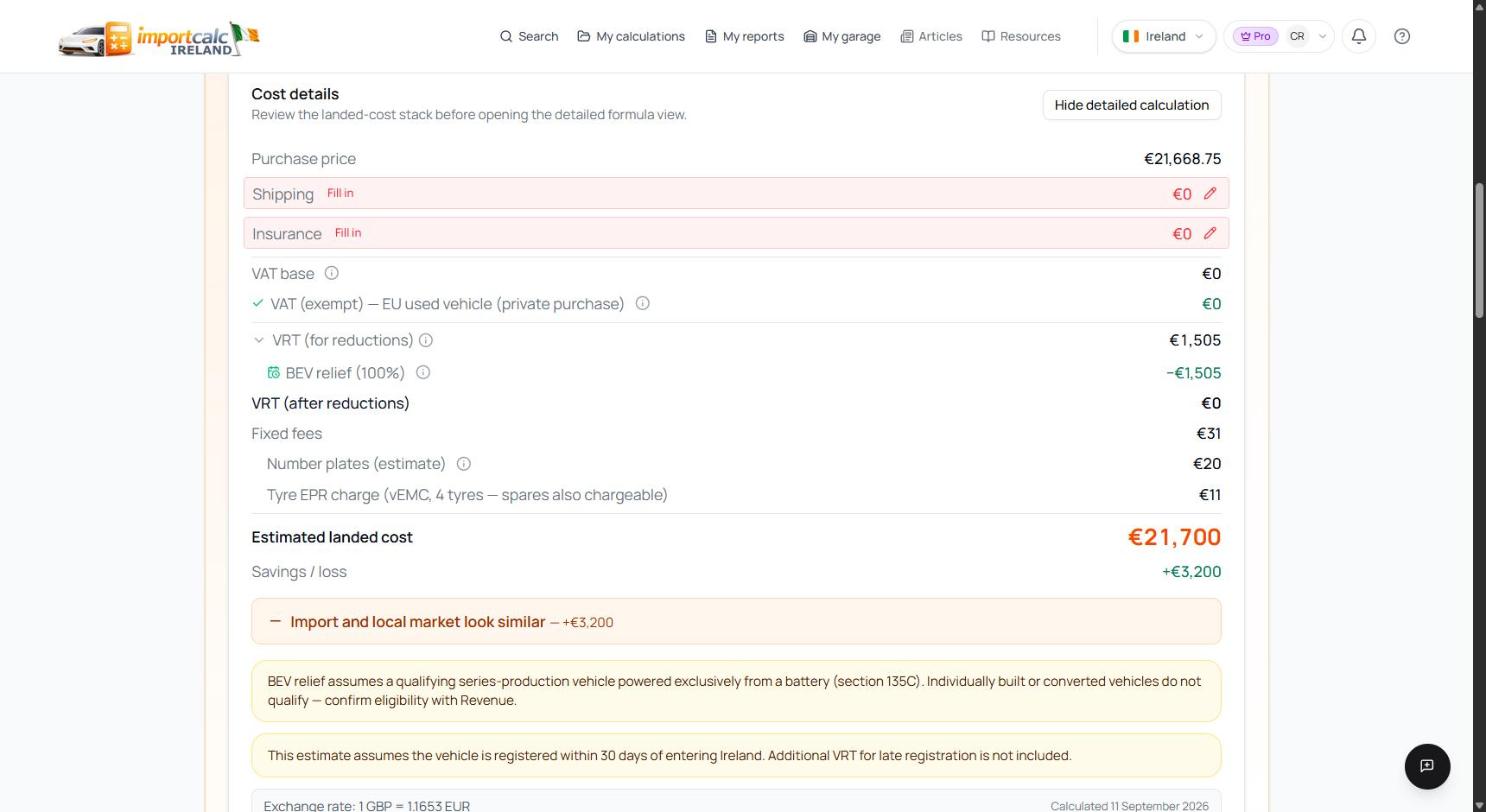
The relief reduces VRT and nothing else. This car is priced on the Northern Ireland route with evidence that Revenue accepts, which keeps customs duty and import VAT at zero. Without that evidence the same ID.4 follows the Great Britain route, and Importcalc adds €2,167 of customs duty and €5,482 of import VAT, with VRT still at zero.
VRT, customs and VAT are separate lines
A used car from Germany or another EU country normally pays no customs duty and no Irish VAT if it is more than six months old and has covered more than 6,000 km. It pays VRT and the NOx levy.
A car from Great Britain pays customs duty where it applies and 23 percent import VAT before it reaches the VRT calculation.
A car from Northern Ireland avoids additional duty and import VAT only with proof that it was legally imported into Northern Ireland.
Does age reduce VRT?
There is no separate age reduction for passenger cars. Age works through the OMSP, which is the current Irish value of that used car, and through the VAT test on cars from the EU.
What to confirm before you rely on an estimate
The exact model, body, engine or battery, and trim.
The exact first registration date.
The official CO2 figure and whether it is WLTP or NEDC.
The official NOx figure.
A value band from cars registered here of the same year, trim and similar mileage.
The purchase origin and the customs or Northern Ireland evidence that goes with it.
The odometer reading on arrival, for the VAT test on a car from the EU.
Importcalc's AI estimates and OMSP research give a planning figure; the car's own documents and Revenue's assessment at registration give the final one.
Frequently asked questions
Is VRT based on what I paid abroad?
No. For a passenger car it is a percentage of the OMSP, Revenue's valuation of the car on the Irish market.
Do plug-in hybrids pay the NOx levy?
Yes. A plug-in hybrid can sit in the lowest CO2 band and still pay the NOx levy on its official figure. Only electric cars are outside it.
What happens if the NOx figure is missing?
Revenue charges the default: €4,850 for a diesel and €600 for other vehicles.
Can an imported electric car have zero VRT?
Yes, if it is a series-production battery-electric car registered before 31 December 2026 and its OMSP is low enough. In the ID.4 example the relief removes the full €1,505.
Is the Importcalc figure the final Revenue bill?
No. It is a planning estimate. Revenue decides the OMSP, the category and the tax at registration.
The calculations in this article were run live on importcalc.com on 13 and 18 September 2026. The German BMW advert and the Newry Volkswagen advert were live on 18 September 2026; the German Mercedes advert was opened on 4 September 2026 and has since been removed. Used-car adverts can change or disappear. VRT bands, NOx rates and the electric-car relief were verified against revenue.ie on 18 September 2026. Revenue determines the final OMSP, classification and tax at registration.