Where the car comes from
Used car from the EU
For a private buyer, a car from Germany or anywhere else in the EU VAT area normally means no customs duty, no Irish VAT provided the car is more than six months old and has covered more than 6,000 km, VRT on the OMSP and the official CO2 figure, and a NOx levy if it is a Category A combustion or hybrid car.
The two VAT thresholds are separate tests and the car has to clear both. A car can be well over six months old and still attract Irish VAT if it has covered 6,000 km or less.
Car from Great Britain
For customs purposes Great Britain sits outside the EU. Revenue's guidance, updated on 24 August 2026, is that a private import needs a customs declaration and MRN, the customs duty shown on that declaration, import VAT at 23 percent on the customs value plus duty, and VRT and NOx at registration. The car cannot be registered without the declaration, and it becomes liable to seizure if it is not declared and registered within 30 days of arrival. The rules apply whether the car comes in directly or through Northern Ireland.
For most passenger cars, 10 percent duty is a reasonable planning assumption where no preference or relief applies; switch to the actual declaration amount as soon as you have it. A British registration is not proof of UK origin for customs purposes.
Duty is charged on the customs value, then VAT is charged on the customs value plus the duty. Together they add just over 35 percent to whatever the car and its freight cost.
Car from Northern Ireland
A Northern Ireland purchase can avoid additional customs duty and import VAT, but only where Revenue accepts the evidence that the car was legally imported into Northern Ireland. The clearest proof is an NI Import Declaration. Where that is unavailable, Revenue may consider the original V5C showing the last registered keeper resident in Northern Ireland, together with Northern Ireland service history and MOT history. An NI plate on its own proves nothing, and without acceptable evidence the car cannot be registered on that route. Until the paperwork is in hand, price the customs fallback alongside the clean route.
Car from another non-EU country
This route normally brings customs duty, import VAT and VRT, plus transport, port handling and type-approval work. Work from the actual customs declaration, and confirm the car can be registered here before anything is shipped.
VRT and the OMSP
For a Category A passenger car, Revenue applies a CO2-based percentage to the Open Market Selling Price. The OMSP is Revenue's estimate of what the car would sell for here at the point of registration, and Revenue says it is usually slightly different from the invoice value.
The rate runs from 7 percent at 50 g/km or below to 41 percent above 190 g/km, across twenty bands, each with a minimum euro amount. The band boundaries are exact: a single gramme can move a car from 21.5 percent to 25 percent. Both cars below are plug-in hybrids under 50 g/km, which is why VRT is a modest line in each. A 150 g/km petrol equivalent would pay 25 percent of OMSP instead of 7 percent.
Battery-electric cars get relief of up to €5,000. It applies in full below €40,000 OMSP, tapers to nothing at €50,000, and covers series-production cars registered before 31 December 2026. On a used EV worth less than €40,000 it cancels the VRT outright.
Importcalc researches an OMSP range, shows the low, the high and the figure it used, and lets you replace that figure with your own before calculating. The final valuation is Revenue's; where you disagree with it, there is a formal appeals process after registration.
The NOx levy
Category A petrol, diesel, hybrid and plug-in hybrid cars pay a separate NOx levy on the official NOx figure in mg/km: €5 per mg for the first 40, €15 per mg for the next 40, and €25 per mg above 80. Electric cars pay no NOx levy.
If you cannot document the figure, Revenue applies a default charge: €4,850 on a diesel and €600 on anything else. On the Mercedes in example 1, a documented 41 mg/km costs €215; the undocumented default on that diesel hybrid would be €4,850. Get the Certificate of Conformity or other official proof before you buy.
Four separate charges
Customs duty depends on the customs route, origin and declaration.
Import VAT depends on the customs rules, or on the EU new-means-of-transport rules.
VRT depends on the registration category, OMSP and technical data.
The NOx levy depends on the vehicle category and official NOx emissions.
A car can face zero customs duty and still owe import VAT. A qualifying EU used car escapes both duty and VAT, and still owes VRT and the NOx levy.
Fixed registration costs
The calculator includes two fixed items: number plates, entered as a market estimate of about €20 because Revenue publishes no plate fee, and the tyre environmental management charge of €2.80 per tyre, including any chargeable spare, collected at the inspection centre. The first NCTS registration appointment carries no separate charge; a €54.76 surcharge applies only if you cancel late, reschedule within five working days or do not show up. Motor tax is a running cost that begins once the car is registered and sits outside the estimate.
Two worked examples, run live
The German case was calculated in Importcalc on 13 September 2026 and the British case on 18 September 2026, both from adverts that were opened and checked on 4 September 2026. The advertised prices and the exchange rate are the real ones; the OMSP is a planning input, because Revenue sets that at registration.
Route and vehicle | Landed and registered | Reference advert here | Reading |
|---|
Germany, 2021 Mercedes GLE 350 de 4Matic | €42,816 | €52,900 | About €10,100 of headroom; the reference car has 33,000 km less on the clock |
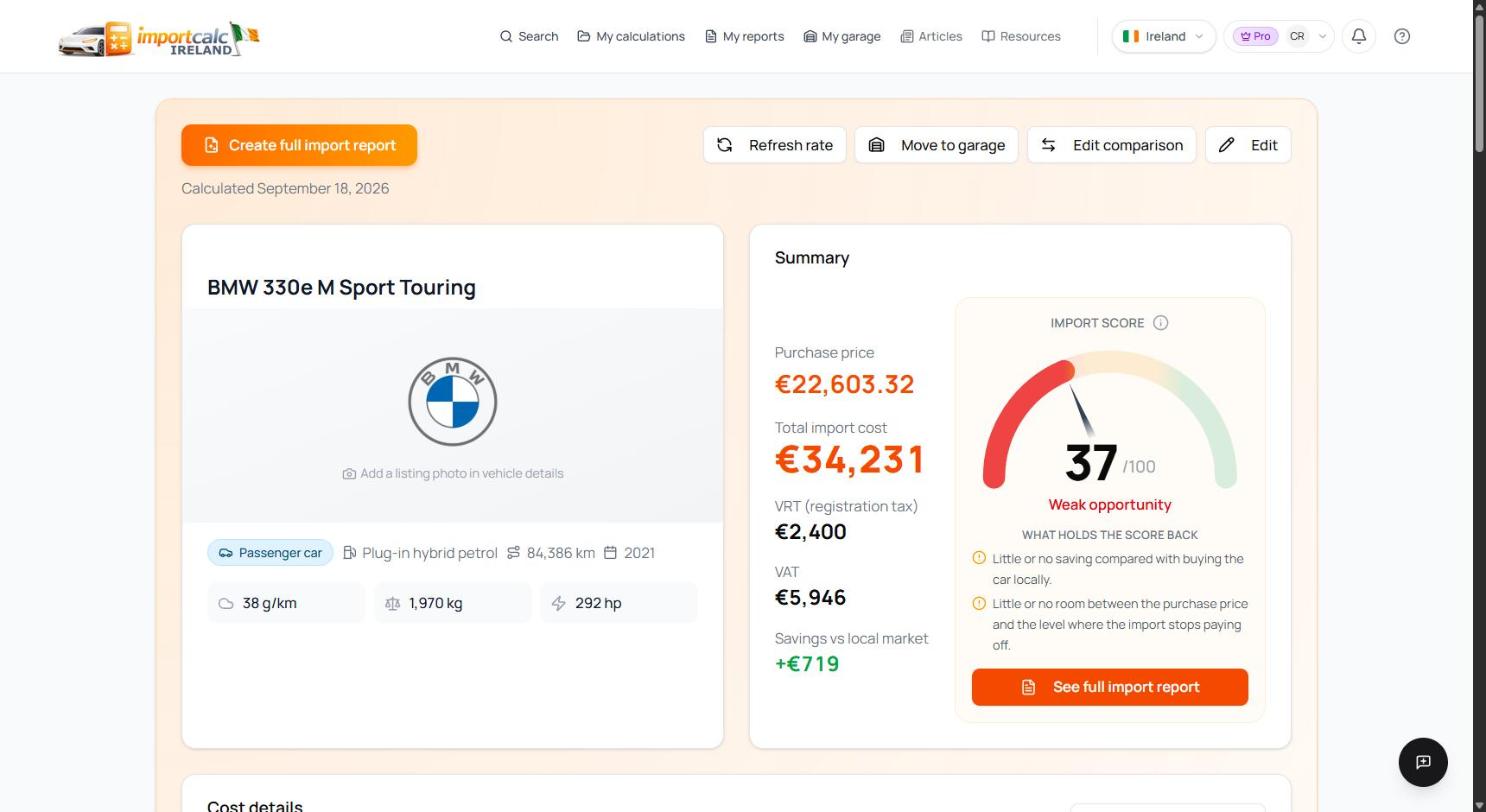
Great Britain, 2021 BMW 330e M Sport Touring | €34,231 | €34,950 | Lands within €800 of the local price; a specification case |
1. Germany, 2021 Mercedes GLE 350 de 4Matic
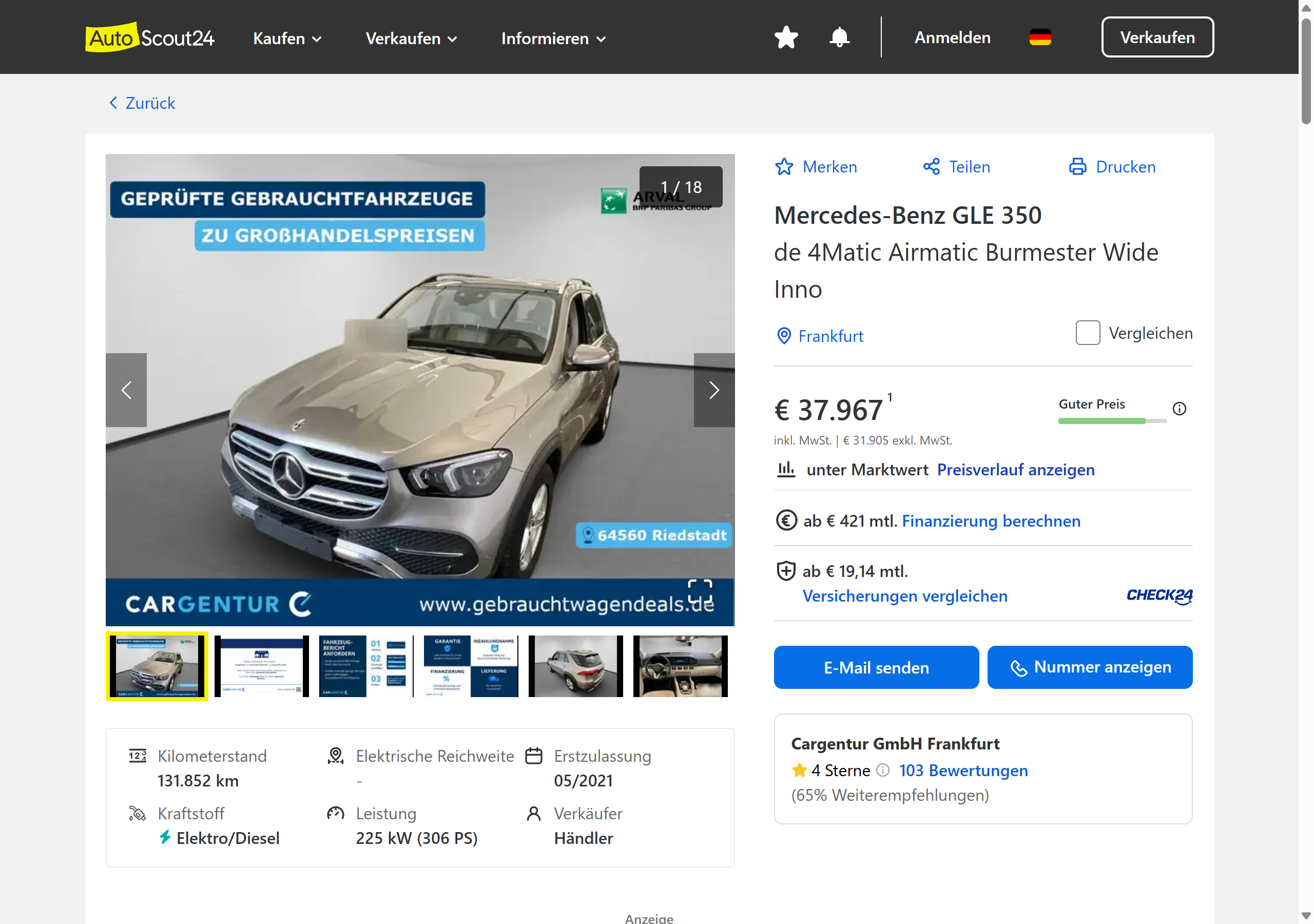
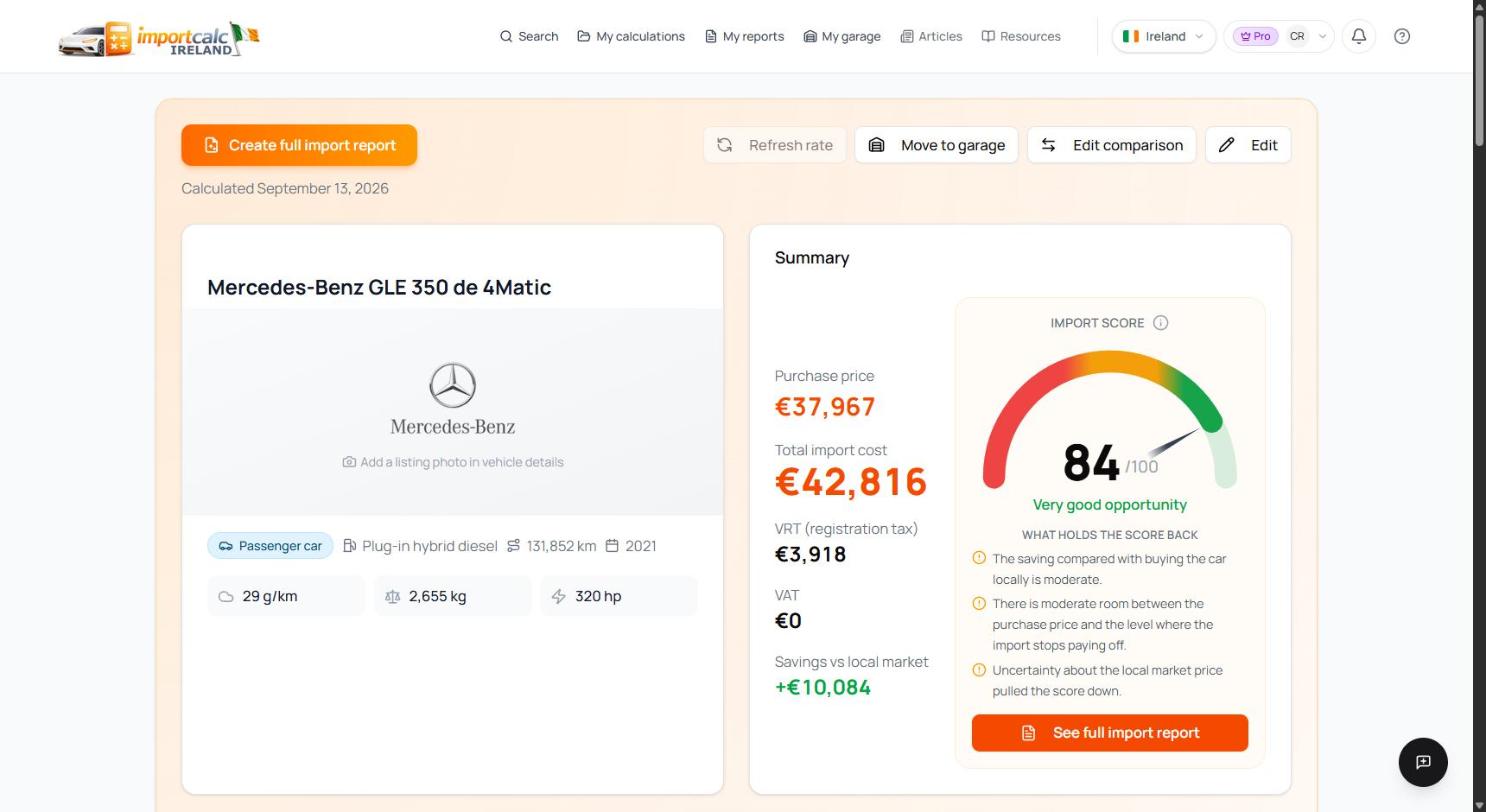
The advert is from Cargentur GmbH in Frankfurt, a dealer selling ex-fleet cars: a GLE 350 de 4Matic with Airmatic and Burmester sound, first registered 05/2021, 131,852 km, one previous owner, listed at €37,967 including German VAT. The price is shown as VAT-deductible for business buyers; a private buyer pays the gross figure, and as a used car from the EU it attracts no Irish VAT.
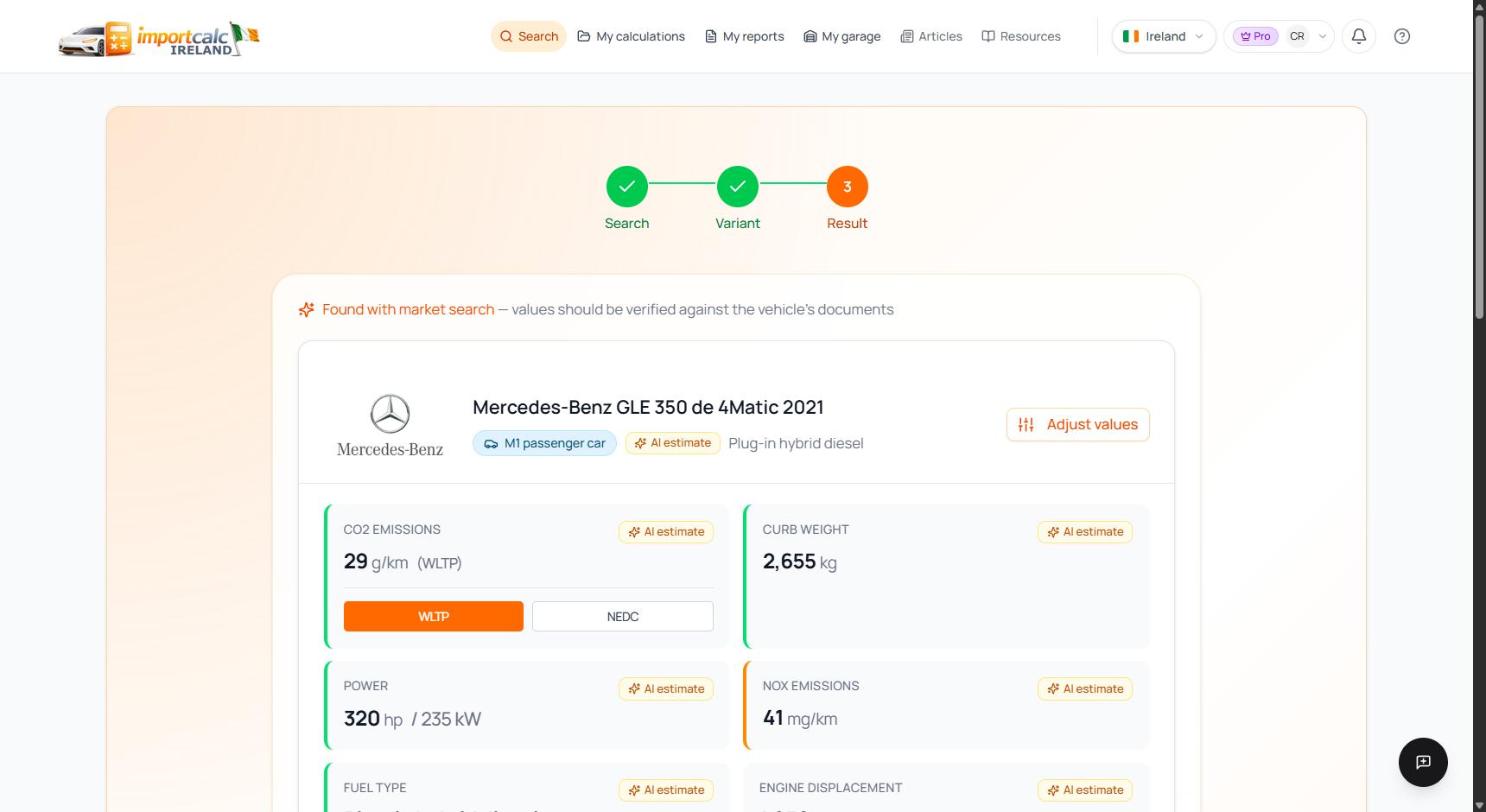
Importcalc identified the variant and returned 29 g/km, 41 mg/km NOx, 2,655 kg and 235 kW before any manual entry; the CO2 figure came flagged as NEDC and was switched to WLTP, the basis a 2021 certificate of conformity carries. Its OMSP research proposed €58,000 with high confidence, inside a researched range of €50,000 to €66,000. Against the dated adverts here that is high for a car with 131,852 km, so the OMSP was set to €52,900, the asking price of the closest opened comparable, a 2021 GLE 350 de AMG with 99,000 km in Dublin. A higher OMSP would raise the VRT, so this is the conservative choice.
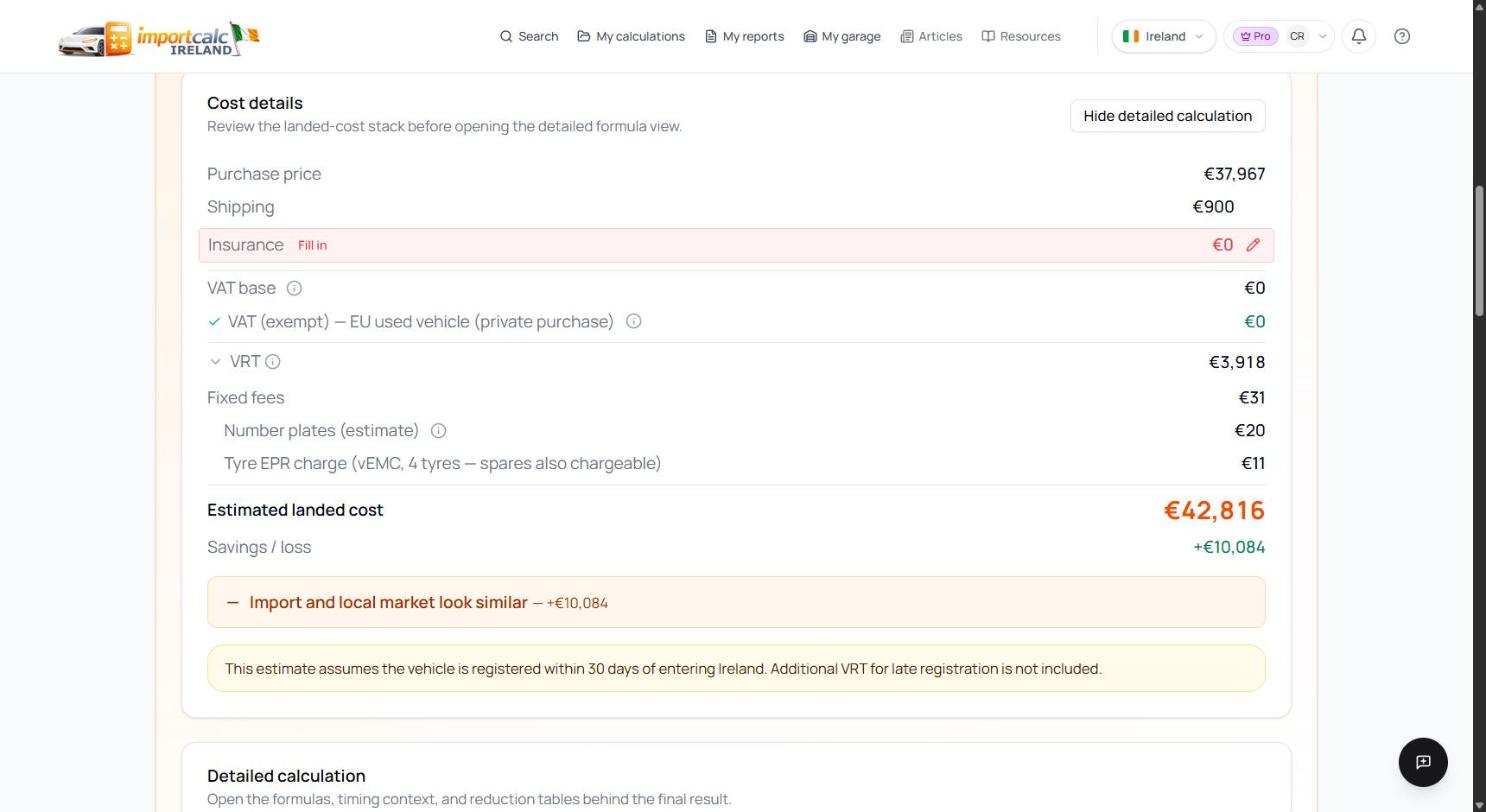
Line | Amount |
|---|
Advertised price (GLE 350 de 4Matic, first registered 05/2021) | €37,967 |
Transport (assumption) | €900 |
Customs duty | €0 |
Import VAT (EU used car, private purchase) | €0 |
VRT (7 percent of €52,900 OMSP) | €3,703 |
NOx levy (41 mg/km: 40 at €5, then €15 per mg) | €215 |
Plates and tyre charge | €31 |
Total, landed and registered | €42,816 |
Against the reference car at €52,900, that is €10,084 of headroom, and Importcalc scores the case 84 out of 100. It is headroom rather than a saving: the reference car has 99,000 km against 131,852 km, and no opened advert here matches this car on both age and mileage. Transport insurance and an inspection are not in the total either. Tax comes to €3,918 on a €42,816 car, because a diesel plug-in hybrid under 50 g/km sits in the lowest VRT band; the purchase price does most of the work.
On 4 September 2026 DoneDeal listed 2021 to 2022 GLE 350 de cars from €50,950 for a 2022 car with 130,000 km to €60,950 for one with 64,631 km, most of them 2022 cars with 90,000 to 150,000 km. Take an OMSP from the top of that range instead and the VRT rises by a few hundred euro, but the fair comparison price rises with it. A saving quoted without matching mileage and specification flatters the car.
2. Great Britain, 2021 BMW 330e M Sport Touring
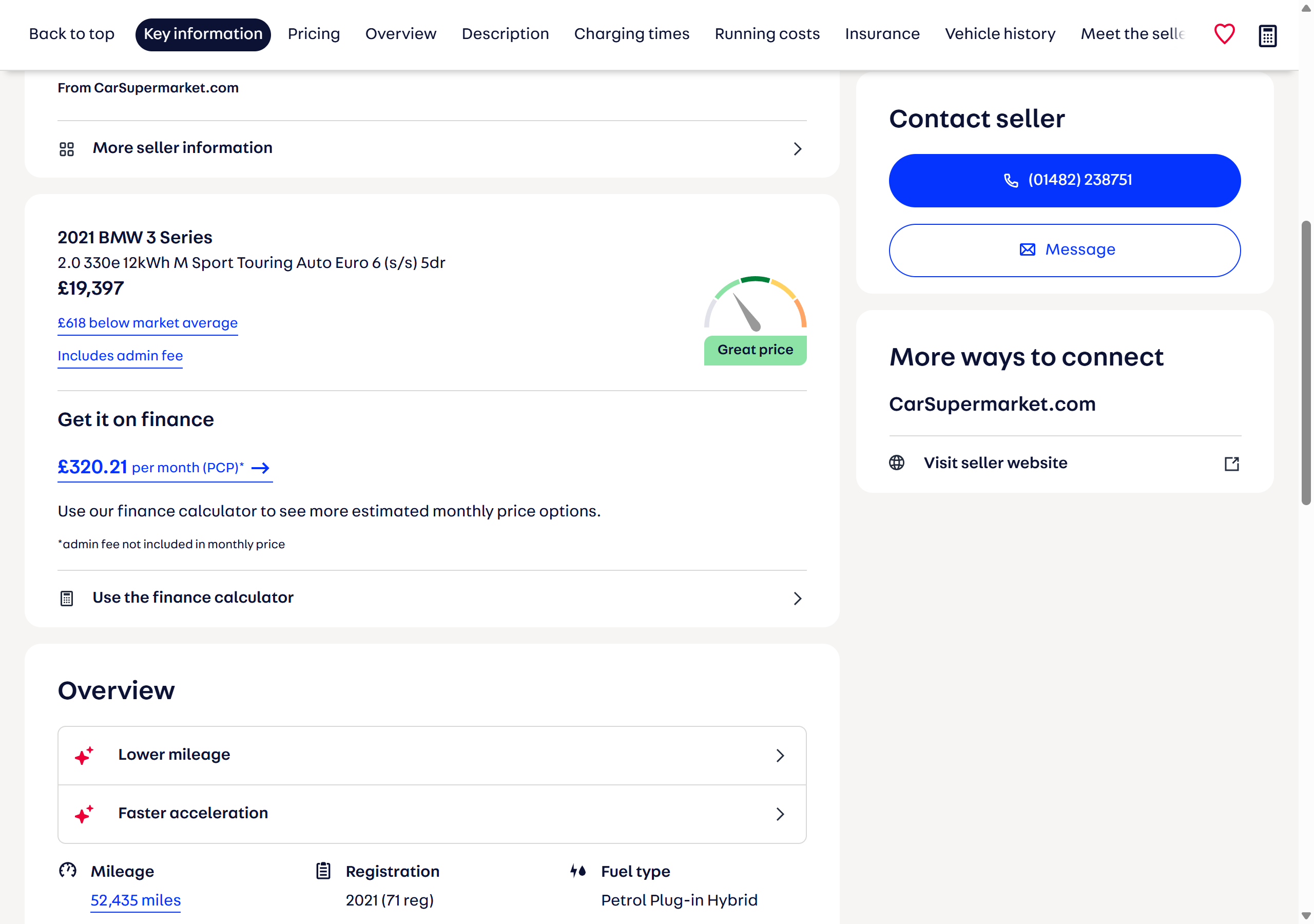
The advert is on Autotrader UK from CarSupermarket.com: a 2021 (71 reg) BMW 330e M Sport Touring, 52,435 miles (about 84,400 km), £19,397 including the admin fee, with a 12-month warranty. The first-registration date is taken as 1 November 2021, inside the 71-plate window, and must be confirmed from the V5C.
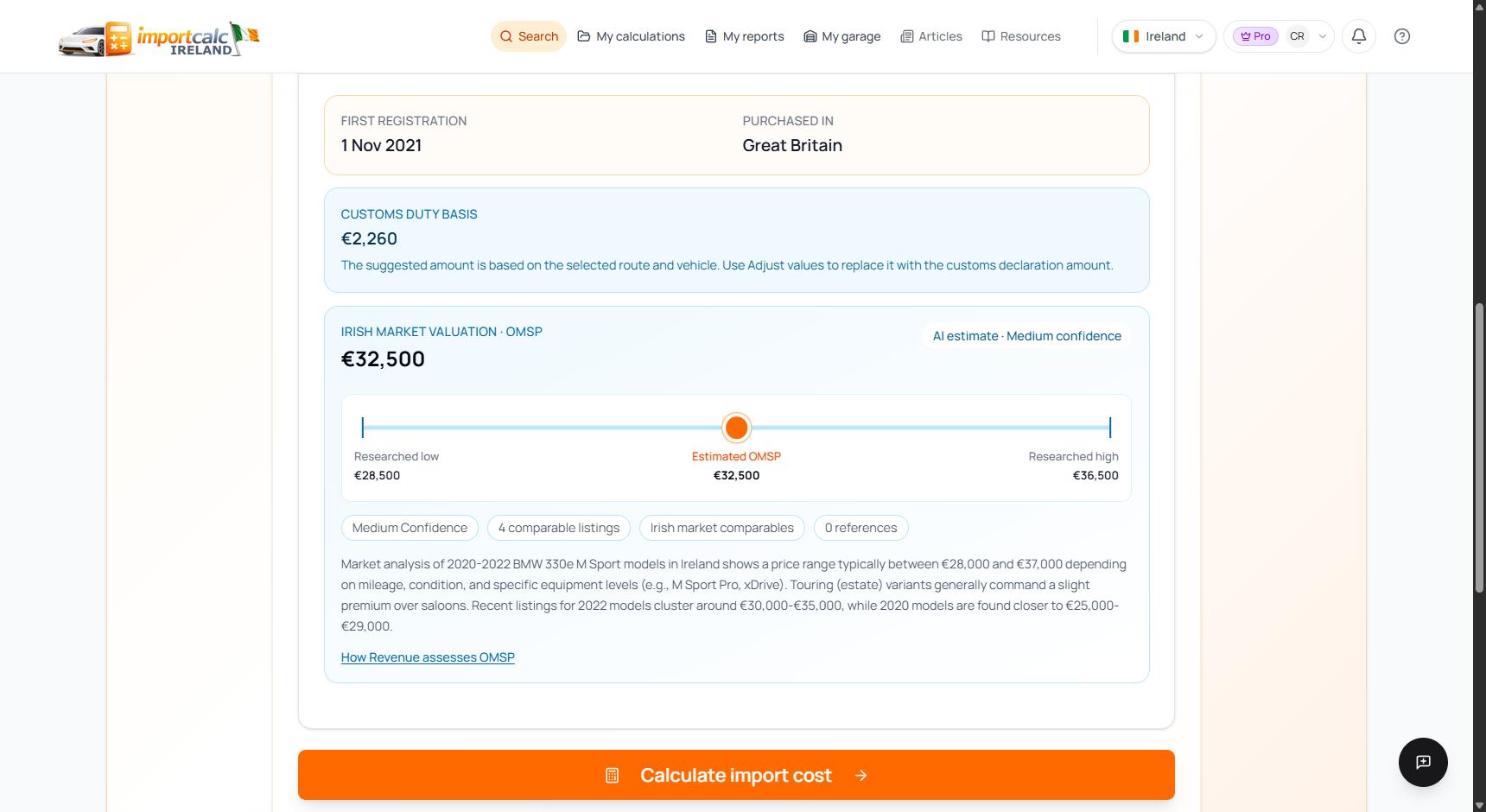
Importcalc returned 38 g/km WLTP, 25 mg/km NOx and 1,970 kg, suggested customs duty at the standard 10 percent rate, and researched an OMSP of €32,500 with medium confidence, inside its range of €28,500 to €36,500. That figure was kept, because the opened adverts here bracket it: a 2022 330e Sport Pro Touring with 71,598 km at €34,950 and a 2022 SE Pro Touring with 149,669 km at €23,900.
Line | Amount |
|---|
Advertised price | £19,397 |
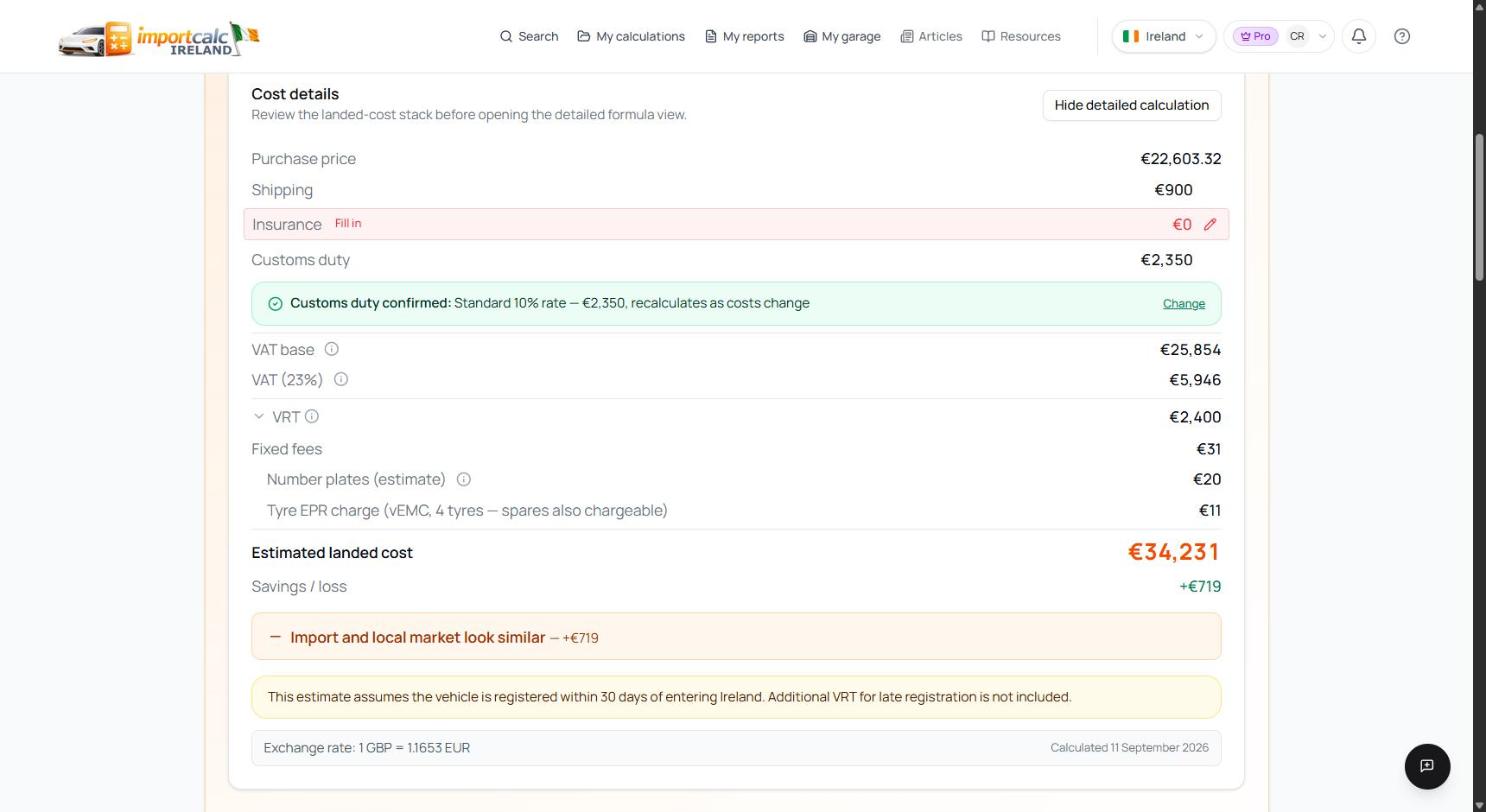
At 1 GBP = 1.1653 EUR (rate of 11 September 2026) | €22,603 |
Transport (assumption) | €900 |
Customs value | €23,503 |
Customs duty at 10 percent | €2,350 |
Import VAT at 23 percent on €25,854 | €5,946 |
VRT (7 percent of €32,500 OMSP) | €2,275 |
NOx levy (25 mg/km at €5) | €125 |
Plates and tyre charge | €31 |
Total, landed and registered | €34,231 |
Duty and VAT alone add €8,296, more than a third of what the car and its freight cost. The €900 transport allowance also lifts the customs value, so duty and VAT rise with it. The finished figure lands €719 under the opened Touring at €34,950, and Importcalc scores it 37 out of 100. It can still be the right car if the Touring body, M Sport specification and condition are hard to find here, and the customs paperwork has to be settled before you commit.
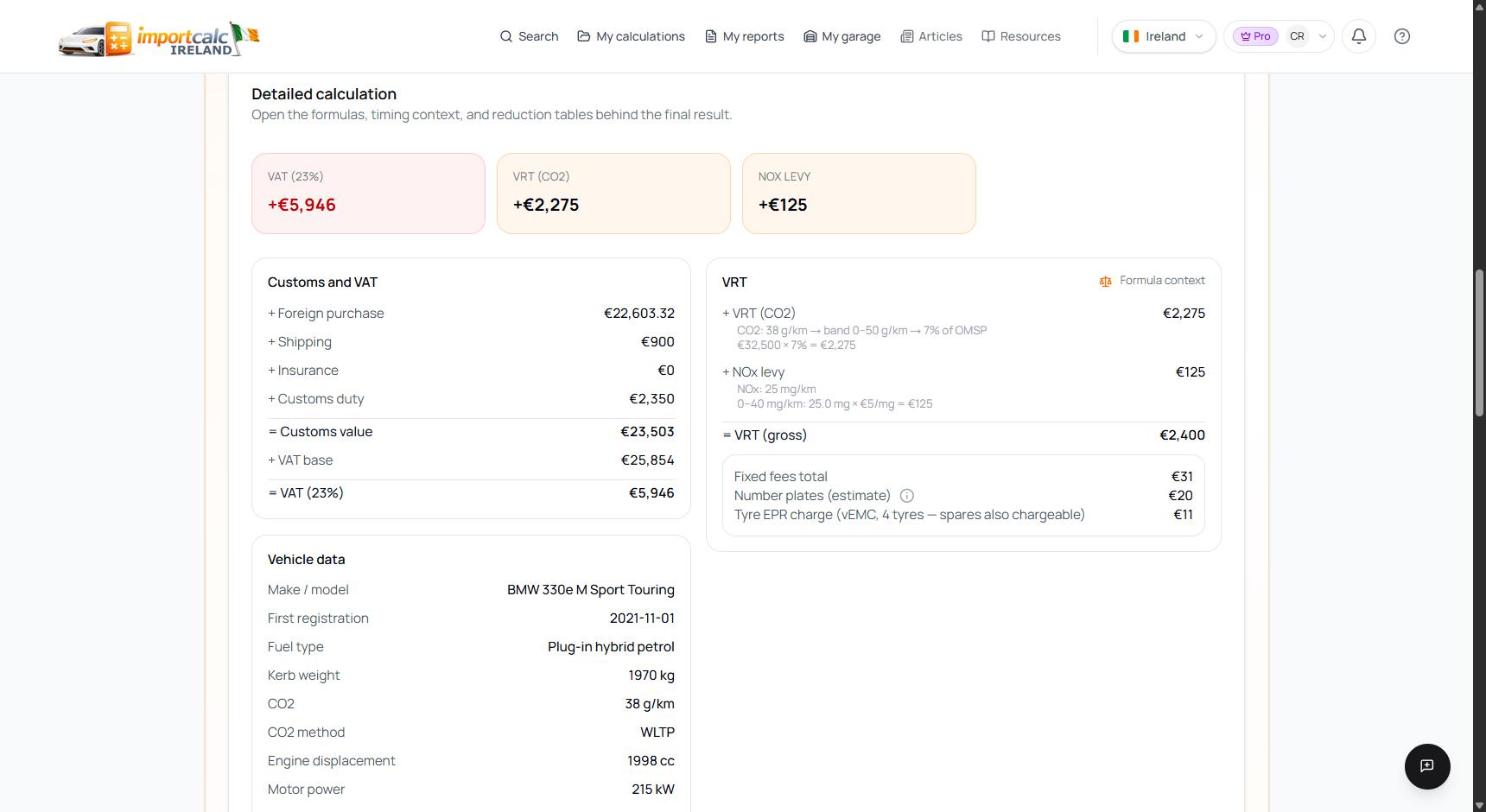
On the Mercedes, tax is €3,918 of a €42,816 total and the German advert price does the work. On the BMW, customs and VAT add €8,296 and close two thirds of a €12,300 gap in asking prices. The same calculation gives opposite answers, and a different line decides each one.
How Importcalc structures the estimate
Enter the vehicle, asking price, currency, first-registration date and purchase origin. Choosing pounds sterling suggests the Great Britain route; change it if the car is elsewhere.
Select the matching variant where more than one is found.
Review CO2, test method, NOx, weight, power, engine capacity and vehicle category, all marked as AI estimates to confirm against the car's documents.
Review the researched OMSP, its low and high, and its references, and replace it with your own figure if the adverts here say otherwise.
Calculate the import result.
Add transport and insurance, and on a customs route replace the suggested duty with the declaration amount; on the EU route, enter the arrival date and odometer so the VAT test uses exact facts.
Enter a local comparison price from an advert here and read the import score.
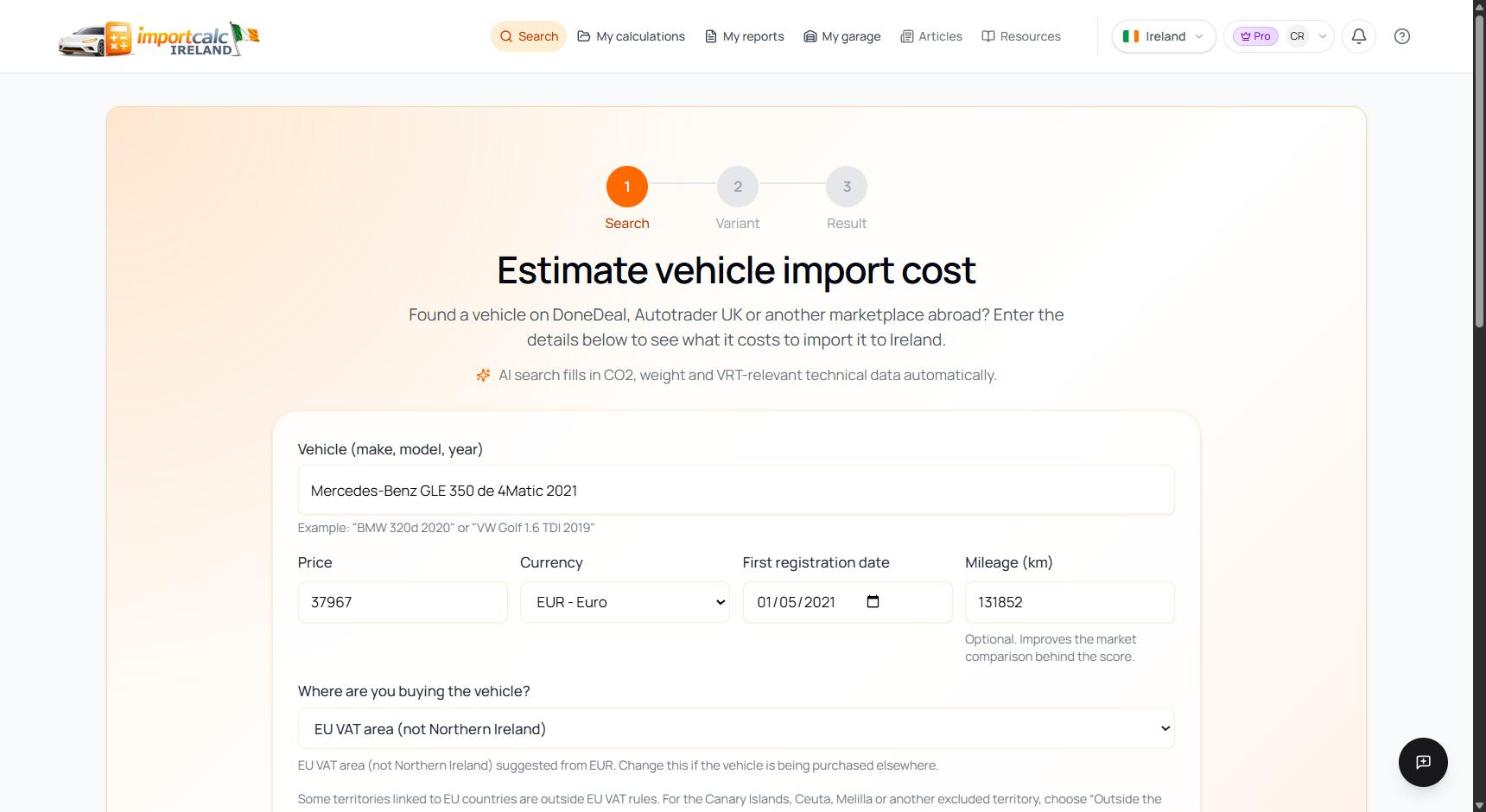
The AI-assisted vehicle and market data speeds up the research. Check every material input against that specific car's official records all the same.
Registration deadlines
Keep proof of the date the car entered the State. From that date, Revenue requires you to make an appointment with the NCTS within seven days and to complete registration within 30 days. Additional VRT of 0.1 percent of the VRT due applies for every day the car is late. On a non-EU route the customs formalities have to be finished before the NCTS process begins, so work the schedule out before the car travels.
In practice that means confirming the car's identity and collecting the original registration document, invoice, Certificate of Conformity and emissions evidence first. On a customs route, arrange the declaration and keep proof of duty and VAT paid. Book the NCTS appointment early, and keep the transport and arrival records, because the clock runs from the date the car entered the State. The calculator assumes registration within 30 days of entry and leaves out any late-registration VRT.
Documents to secure
The advert is fine for screening. Before money changes hands, confirm the calculation against these:
The original foreign registration document, the VIN and exact model variant, the exact first-registration date, service history, recall status, accident record and finance-clearance evidence.
The Certificate of Conformity or accepted type-approval evidence, with the official WLTP CO2 figure (or the NEDC figure and test method where Revenue's conversion applies), NOx emissions in mg/km, engine displacement, fuel type, power and vehicle category.
The odometer reading at the arrival date, for the VAT test on a car from the EU.
A purchase invoice with full seller and vehicle details and VAT wording; customs-origin evidence where you are claiming a preference or relief; NI status evidence for a Northern Ireland purchase; transport and insurance quotes; warranty terms.
A missing NOx figure is the most expensive gap on this list. A model name lifted from a marketplace listing is not evidence of a low NOx figure.
Comparing with cars already registered here
Compare like with like. The reference car should already be registered with VRT paid, since the import total includes Irish taxes and registration. Leave finance deposits, ex-VAT commercial prices, damaged stock and cars with unclear tax status out of the comparison. Then match the car itself: engine, drivetrain, battery and body style, trim and major equipment packs, model year within one year, similar mileage, seller type, warranty and history.
Where the match is looser than that, the euro difference is headroom, not a saving, which is why example 1 is described that way. If local supply is too thin to find a match, show the nearest cars as context and drop the percentage. Thin supply is itself a reason to import, particularly when the foreign market has the exact engine, colour, battery or option pack that is missing here.
Which source market fits the car
Germany is the obvious starting point for premium cars, EVs, plug-in hybrids and specific equipment combinations. Supply is deep, and the EU route can keep customs duty and Irish VAT at zero on a qualifying used private purchase. The catch is left-hand drive, so the specification and the price have to justify it.
Great Britain has the deepest right-hand-drive supply, which makes estates, performance trims and unusual option combinations easier to find. Since Brexit, customs duty, import VAT and origin evidence all sit in the calculation, and as example 2 shows they can add more than a third to the landed cost. The asking-price gap has to be wide to survive that.
Northern Ireland offers right-hand drive and much shorter logistics, and its favourable tax route depends on vehicle-specific evidence. Japan supplies specialist right-hand-drive stock, at the cost of sea freight, a third-country customs entry and Japanese emissions documents. Belgium and the Netherlands are worth a look for company cars and EVs with detailed service histories, and France for mainstream and French-brand stock.
Related guides: VRT on imported cars explained, Importing a car from the UK to Ireland, Importing an electric car to Ireland and Is it still worth importing a car to Ireland?
Frequently asked questions
How much does it cost to import a car to Ireland?
It depends on the source country, purchase price, logistics, OMSP, CO2, NOx and vehicle category. The two examples above carry €3,918 and €10,696 of Irish tax, which is why a route-specific calculation beats a rule-of-thumb percentage.
Do I pay VRT on a used car from Germany?
Yes. A qualifying EU used car normally avoids customs duty and Irish VAT, but VRT and the NOx levy still apply.
Do I pay VAT on a used car from the UK?
From Great Britain, yes: 23 percent import VAT on the customs value plus duty, with the customs declaration as proof at the NCTS. From Northern Ireland, additional duty and VAT stay at zero only with accepted evidence of the car's NI status.
How much is the NOx levy if I have no documentation?
€4,850 on a diesel, €600 on anything else. On a car with a documented 41 mg/km figure the levy would be €215.
Is the NCTS registration appointment free?
There is no separate charge for the registration service. A €54.76 surcharge applies if you cancel late, reschedule within five working days or fail to appear.
Can I know the exact VRT before buying?
You can get close with the official emissions figures and a realistic OMSP. Revenue makes the final call on OMSP, classification and tax, and its valuation can be appealed after registration with evidence of comparable sales here.
In short
The route comes first, then every tax line, then the documents, then a fair comparison with a car already registered here. On the Mercedes the purchase price decides it, on the BMW it is customs and VAT, and on a diesel without a NOx certificate a single document can cost €4,635. Calculating early leaves time to inspect, negotiate and hold back a contingency.
This market snapshot was checked on 4 September 2026, and the calculations were run live on importcalc.com on 13 and 18 September 2026; by 13 September the German advert had been removed from AutoScout24. The German advert, the British advert and the four reference adverts named above were opened and live on 4 September 2026; used-car adverts can change or disappear. The wider price bands come from same-day DoneDeal search results whose listing pages were not opened, so they are market context only and no savings claim rests on them. VRT bands, NOx rates and the BEV relief were verified against revenue.ie on 4 September 2026. Revenue determines the final OMSP, classification and tax at registration.