Four source markets cover almost every import: Northern Ireland, Great Britain, Japan and the rest of the EU. They are not taxed alike, so the route decides whether customs duty and import VAT apply, what evidence Revenue expects, and how much of the gap between a foreign advert and an Irish price is left by the time the car has Irish plates.
The four routes are compared below, with three real adverts priced live in Importcalc in September 2026. One of them, a Volkswagen ID.4 in Newry, lands about €3,200 under the closest Irish car with the right paperwork and about €4,450 over it without. The car and the price are identical; the paperwork makes the difference.
The four source markets at a glance
Source market | Steering | Main advantage | Main cost or evidence issue |
|---|
Northern Ireland | Right-hand drive | Closest route, familiar cars, no additional customs duty or import VAT on a qualifying car | You need proof Revenue accepts that the car was legally imported into Northern Ireland |
Great Britain | Right-hand drive | The deepest supply and the widest choice of specification | Customs duty and 23 percent import VAT come before VRT |
Japan | Right-hand drive | Specialist, performance and hybrid stock | Sea freight, non-EU import taxes, translations and Japanese emissions evidence |
Germany and the EU | Mostly left-hand drive | A very large market, no customs duty, no Irish VAT on a qualifying used car | Left-hand drive, and longer logistics |
Every route pays VRT and, for anything with an engine, the NOx levy. Those are set by the Irish value of the car and its emissions, so they are the same whichever border the car crosses. What the route changes is everything that comes before VRT.
Northern Ireland: the first place to check
A used car bought in Northern Ireland can be registered here without customs duty and import VAT if it was legally imported into Northern Ireland. Revenue's guidance, published on 24 August 2026, names the proof: an NI Import Declaration. Where that is not available, for example because the car has changed hands since it was imported, Revenue may at its discretion accept other proof, and it requires as a minimum the original V5C showing that the last registered keeper is resident in Northern Ireland, a Northern Ireland service history and a Northern Ireland MOT history. Everything is subject to verification, and without the proof the car cannot be registered on this route.
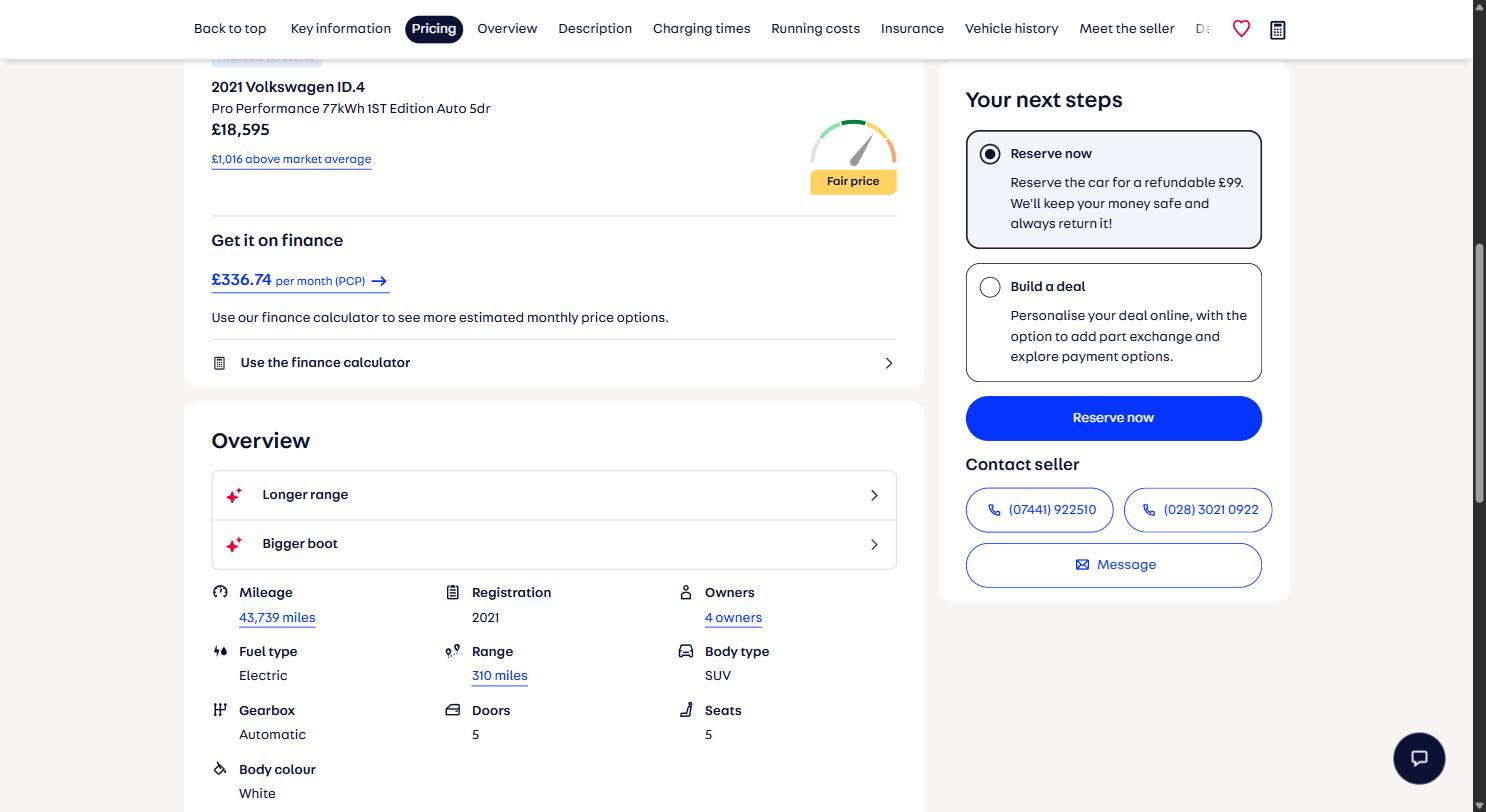
The live example is an Autotrader advert from Kehoe Kars in Newry, opened and checked on 18 September 2026:
2021 Volkswagen ID.4 Pro Performance 77kWh 1ST Edition, white
43,739 miles, about 70,400 km, four owners
£18,595, which Autotrader flags as £1,016 above the UK market average
Importcalc asks the evidence question directly. When you choose Northern Ireland as the purchase origin, the form asks whether you can provide proof that Revenue accepts for qualifying Northern Ireland status. Without it, the estimate follows the Great Britain import route.
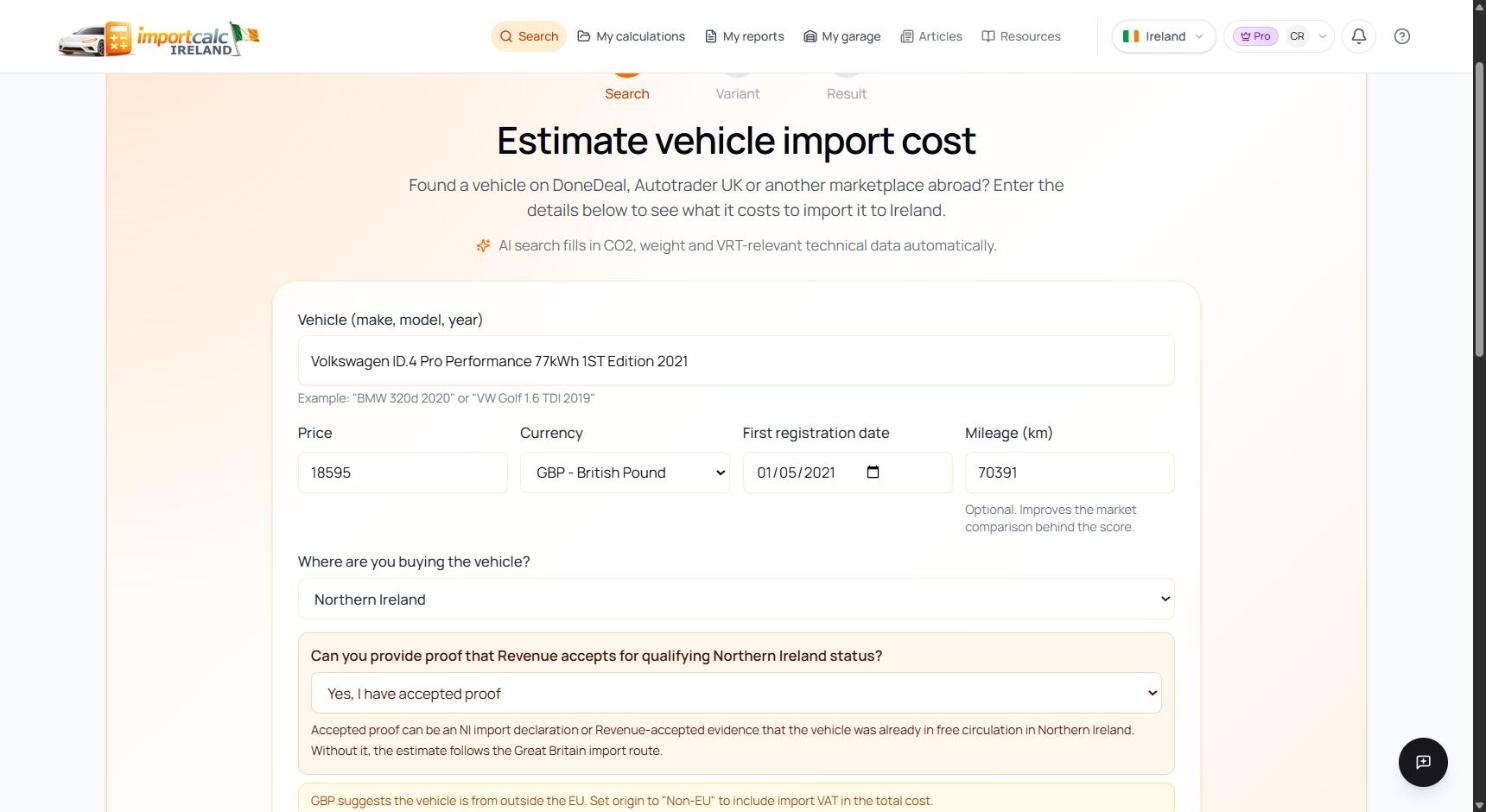
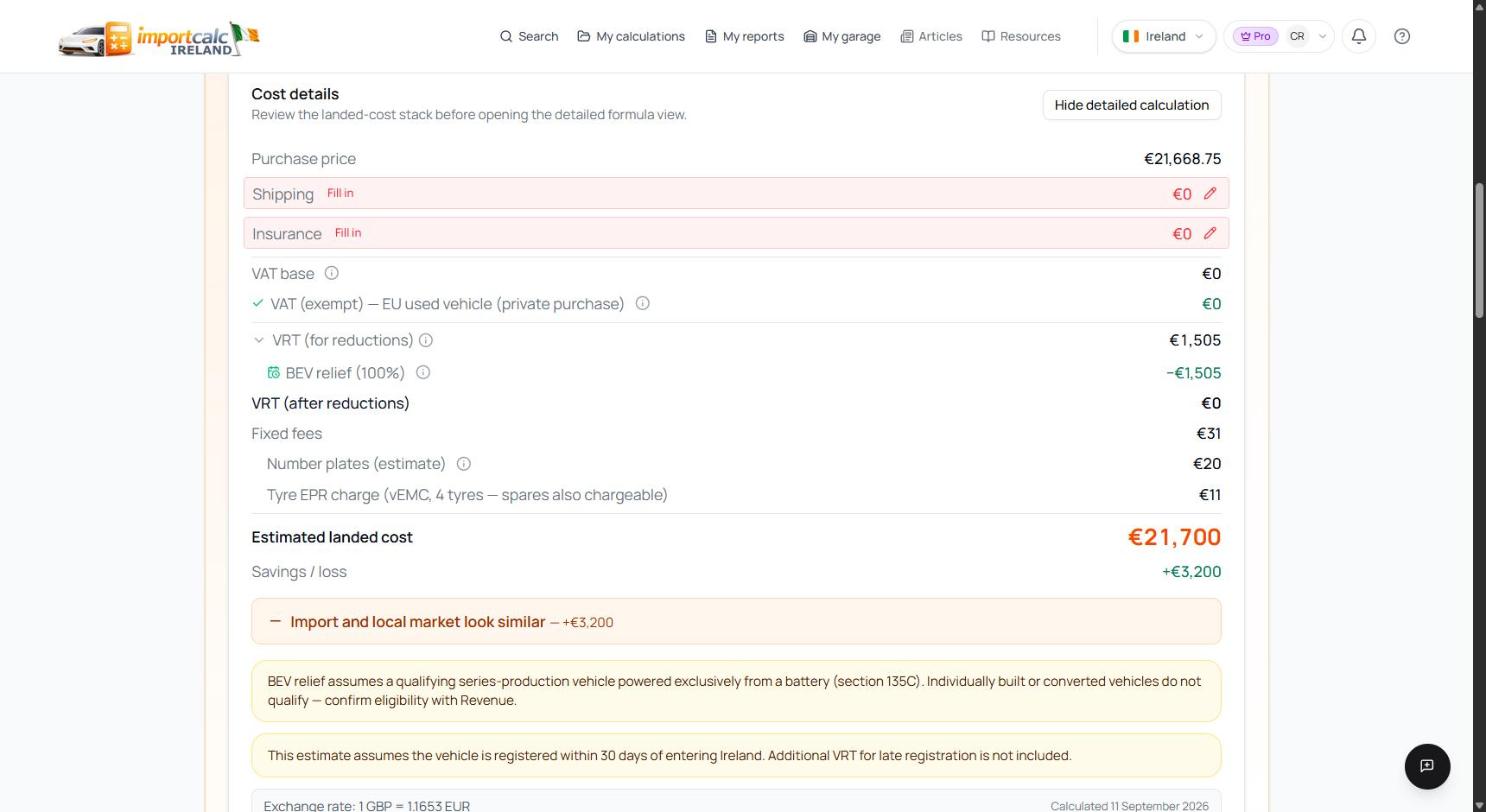
The calculation was run both ways. The first registration date is assumed to be 1 May 2021 because the advert gives only the year. Importcalc recognised the car as electric with 0 g/km and researched an OMSP of €21,500 with medium confidence. As a battery-electric car with an OMSP under €40,000 it gets full VRT relief until the end of 2026, so VRT is zero on both routes.
Line | Proof accepted | No accepted proof |
|---|
£18,595 at 1 GBP = 1.1653 EUR | €21,669 | €21,669 |
Customs duty at 10 percent | €0 | €2,167 |
Import VAT at 23 percent | €0 | €5,482 |
VRT (7 percent of €21,500 OMSP) | €1,505 | €1,505 |
Electric-car relief | −€1,505 | −€1,505 |
Plates and tyre charge | €31 | €31 |
Total to Irish plates, before collection | €21,700 | €29,349 |
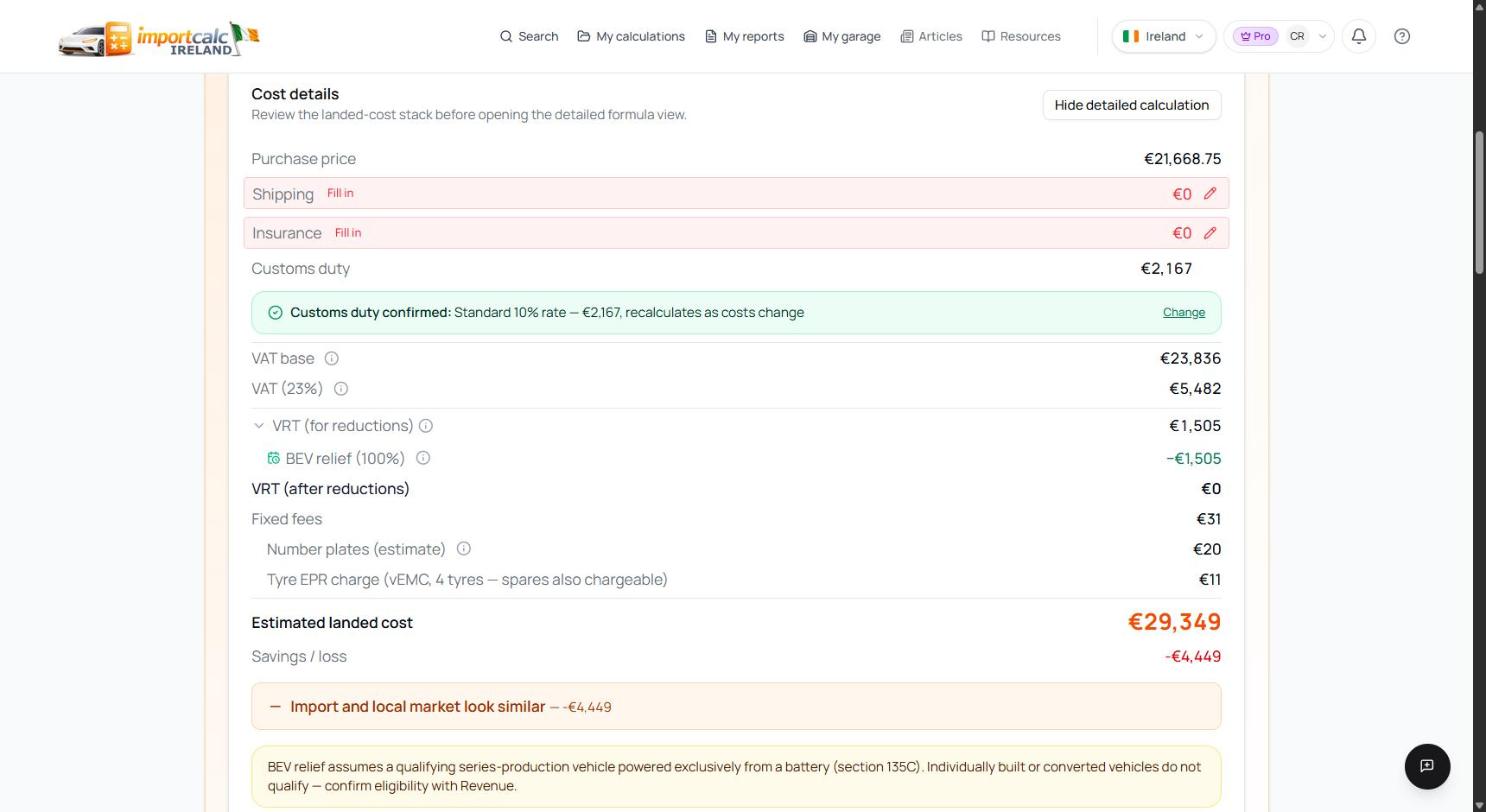
On 18 September 2026 the two closest Irish cars on DoneDeal, both opened and checked, were a 2021 ID.4 Tech 77kWh with 69,530 km at €24,900 and a 2021 ID.4 1ST Max 77kWh with 76,687 km at €24,995, both from Dublin dealers. Same-trim 1ST Edition cars in the search results had 107,000 km or more and asked €21,995 and under; those adverts were not opened. With accepted proof the Newry car lands about €3,200 under the closest Irish car, before the cost of collecting it. Without proof it lands about €4,450 over. The trims differ, so this is headroom and not a savings percentage. Importcalc scores the first case 45 out of 100 and the second 17.
The gap between the two totals is €7,649, and it comes down to documents. A five-year-old car with four owners may well have spent part of its life in Great Britain, which is exactly when the import declaration matters. Ask for the evidence before paying a deposit, and price the fallback until you have it.
Great Britain: deep supply, heavier tax
England, Scotland and Wales have the widest choice of right-hand-drive cars by a distance. Since 1 January 2021 a car from there is a non-EU import: it needs a customs declaration, customs duty where it applies, and 23 percent import VAT on the customs value plus the duty, all before VRT. A zero duty rate is possible only for a car of UK origin with proof of that origin. A British registration does not prove it.
The live example is a 2021 BMW 330e M Sport Touring from the dealer Carsa on Autotrader, 43,498 miles, at £19,986, checked on 18 September 2026. With €900 for transport, Importcalc adds €2,419 of duty and €6,120 of VAT, then €2,400 of VRT and NOx, for a landed €35,160.
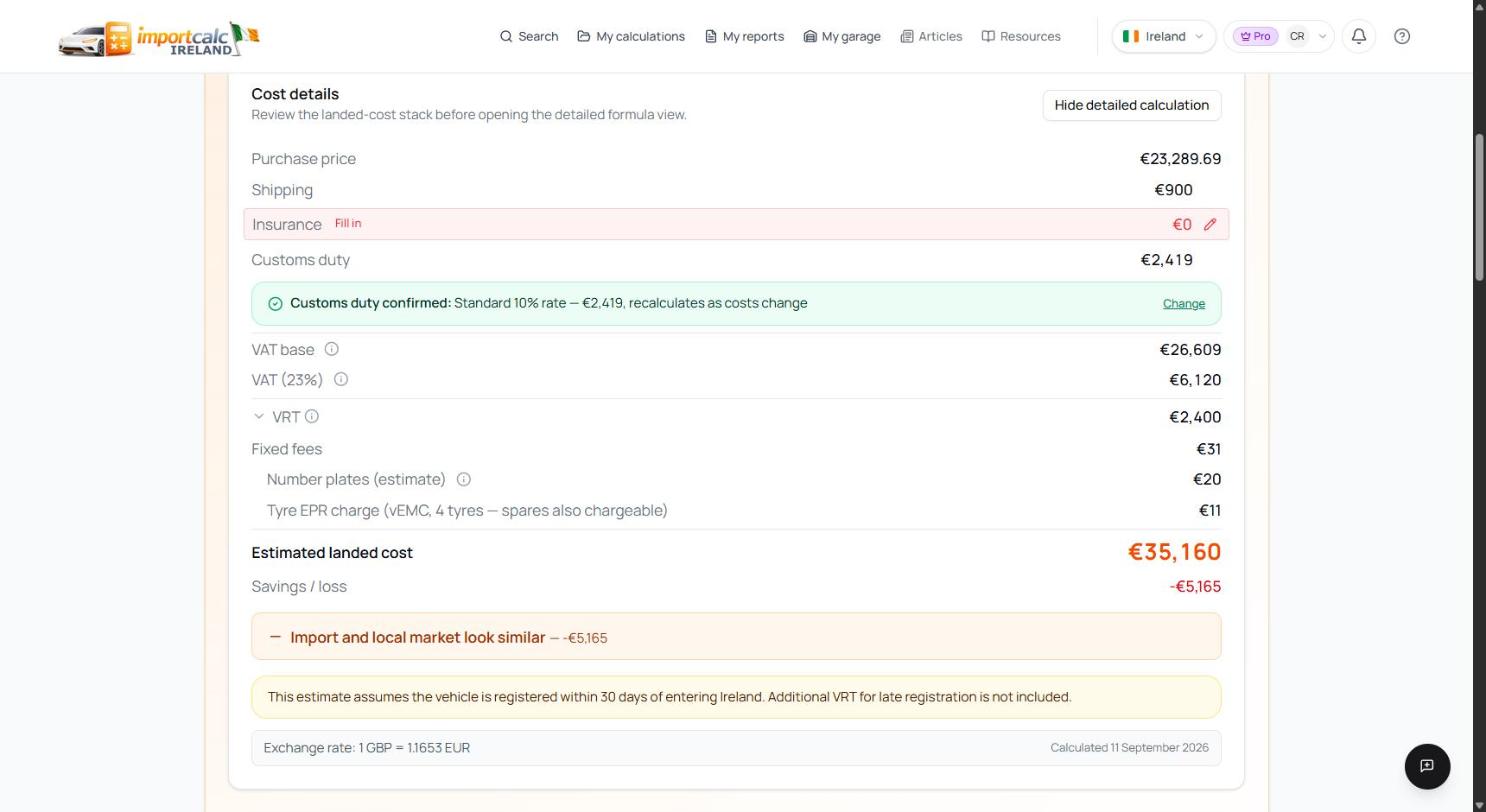
Irish 330e estates with similar mileage ran from €29,995 for a 2021 SE Pro to €36,450 for a 2023 M Sport on the same day, so the import lands in the upper half of the local band and €5,165 above the closest car on age and mileage. Importcalc scores it 23 out of 100. Great Britain makes sense when the exact car is scarce here: an estate, a performance trim, a colour and options you cannot find. It rarely makes sense on price alone.
Germany and the EU: left-hand drive, no duty
A used car from Germany or another EU country normally pays no customs duty and no Irish VAT, provided it is more than six months old and has covered more than 6,000 km. The catch is that almost everything there is left-hand drive, so this route is for premium cars, plug-in hybrids, electric cars and specifications that are hard to find in right-hand drive.
The live example is a 2021 Mercedes GLE 350 de 4Matic from a Frankfurt dealer at €37,967 with 131,852 km, opened on 4 September 2026 and calculated on 13 September. With €900 for transport, the only Irish charges are €3,703 of VRT at 7 percent of a €52,900 OMSP, a €215 NOx levy and €31 of fixed fees. It lands at €42,816, about €10,100 under the closest Irish advert at €52,900, which had 33,000 km less on the clock. Importcalc scores it 84 out of 100.
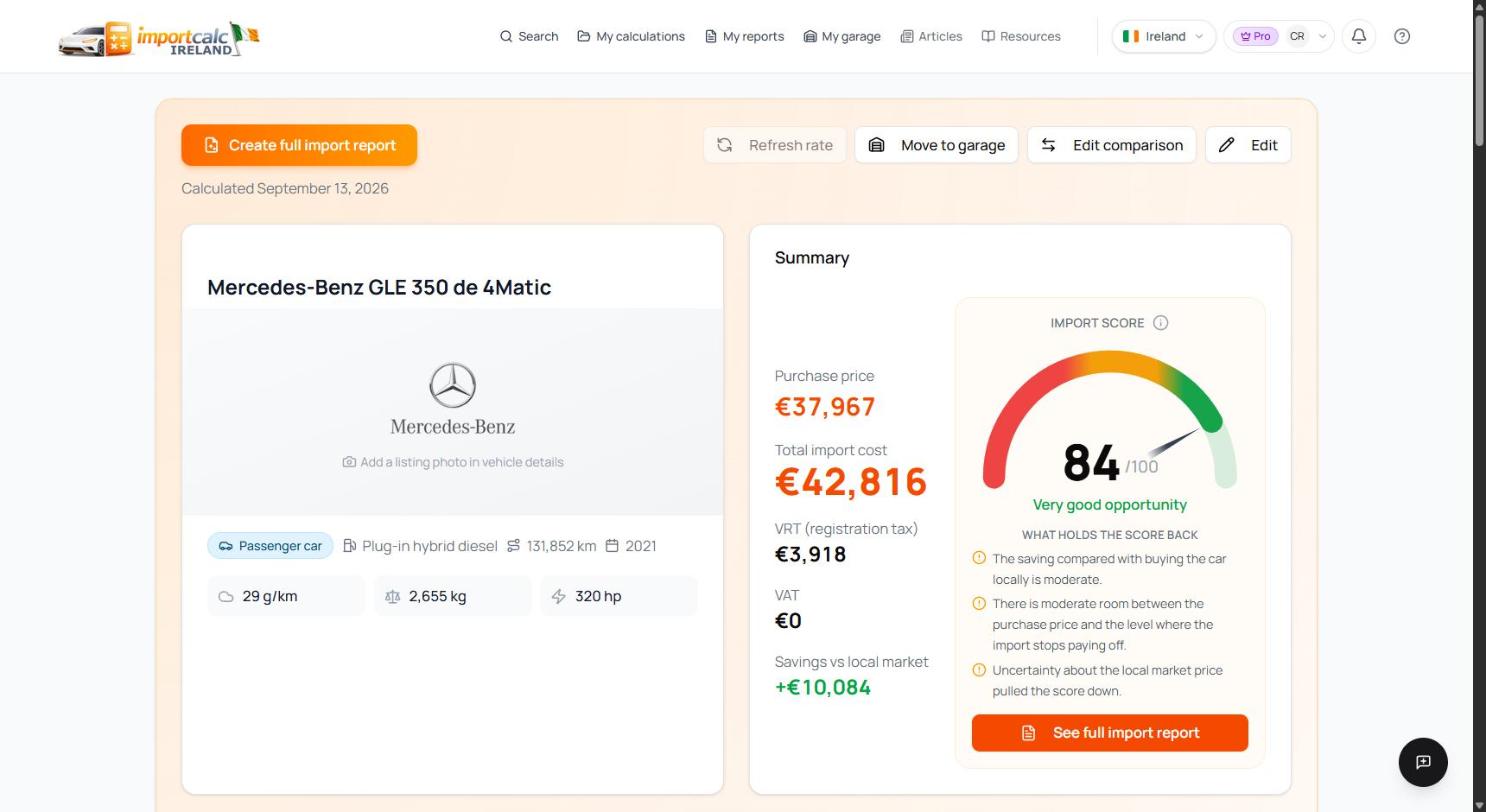
That is the widest margin of the three, because nothing is added before VRT and a plug-in hybrid under 50 g/km sits in the lowest band. The German advert has since been removed, which is normal for a well-priced car.
Japan: a project of its own
Japan supplies right-hand-drive cars that never came to Europe, along with performance models and hybrids in unusual specifications. It is a non-EU import, so customs duty and import VAT apply as they do from Great Britain, on a customs value that includes sea freight and insurance. Importcalc offers a 0 percent preferential duty option for a car manufactured in Japan, on the condition that you hold valid proof of origin under the EU trade agreement. Without proof the standard rate applies.
The registration evidence is specific. The NCTS asks for the Japanese Export Certificate and confirmation of the car's CO2 and NOx emissions from the website of the Japanese Ministry of Land, Infrastructure and Transport, with certified English translations. The vehicle description and weight have to match the export certificate. Where evidence of CO2 and NOx at the time of manufacture is not available, VRT is charged at the highest applicable rates. Budget for an agent, auction or exporter fees, inland transport in Japan, freight, port charges and the wait, and price the car only when you know what the documents will say.
The three live cases side by side
Route and car | Total to Irish plates | Closest Irish advert | Reading |
|---|
Northern Ireland, 2021 VW ID.4 1ST Edition, proof accepted | €21,700 | €24,900 | About €3,200 of headroom before collection |
The same ID.4, proof not accepted | €29,349 | €24,900 | About €4,450 dearer than buying here |
Great Britain, 2021 BMW 330e M Sport Touring | €35,160 | €29,995 | A specification decision, with no saving on price |
Germany, 2021 Mercedes GLE 350 de | €42,816 | €52,900 | About €10,100 of headroom, in left-hand drive |
These are different cars, so this is not a ranking of routes. None of the Irish adverts is a strict match on year, trim and mileage, which is why the gaps are described as headroom and no savings percentages are quoted.
How the taxes stack
VRT is the rate for the car's CO2 band multiplied by Revenue's Open Market Selling Price, the Irish value of the car. The rates run from 7 percent up to 50 g/km to 41 percent above 190 g/km. What you paid abroad does not enter into it.
The NOx levy is separate: €5 per mg/km for the first 40, €15 for the next 40 and €25 above 80. Without evidence of the figure, Revenue charges €4,850 on a diesel and €600 on other cars.
Battery-electric cars registered before 31 December 2026 get VRT relief of up to €5,000, in full up to an OMSP of €40,000.
On a non-EU route, customs duty is charged on the price plus transport and insurance, and 23 percent import VAT on that value plus the duty.
On the EU route, a car still counts as new for VAT if it is less than six months old or has covered 6,000 km or less. Either one is enough.
Registering the car
From the day the car enters the State you have seven days to make an NCTS appointment and 30 days to register it. After 30 days Revenue adds additional VRT of 0.1 percent of the VRT due for every day since the car first entered. On a customs route the declaration has to be complete first, and the car is liable to seizure if it is not declared and registered within the 30 days. If you disagree with the OMSP or the tax charged, Revenue has a VRT appeals process, and its decisions can be appealed onwards to the Tax Appeals Commission.
A practical buying sequence
Pick the route first. For mainstream cars check Northern Ireland, then Great Britain. Use Japan for specialist stock and the EU when a specific car justifies left-hand drive.
Ask for the registration document and the emissions evidence before you trust a low estimate.
Calculate the purchase price, logistics, duty, import VAT, VRT, NOx and fixed charges as separate lines.
Run the fallback: a higher OMSP, a weaker euro, missing Northern Ireland proof, the standard duty rate.
Compare the total with cars of the same year, trim and mileage that are already registered here.
Only then pay a deposit, book transport and prepare the registration file.
Common mistakes
Comparing the foreign advert price with a retail price here.
Treating a Northern Ireland seller or number plate as proof of the car's status.
Entering zero customs duty without proof of origin.
Using the purchase price as the OMSP.
Leaving the NOx figure to chance and meeting the default charge at registration.
Missing the 30-day registration deadline.
Frequently asked questions
Which country is cheapest to import a car from?
It depends on the car and the route. A Northern Ireland car with accepted proof and a used EU car carry the least tax before VRT. Great Britain and Japan add customs duty and 23 percent import VAT. The car, its OMSP and its emissions decide the rest.
Do Northern Ireland cars avoid customs duty and VAT?
Only where the car was legally imported into Northern Ireland and you can prove it to Revenue's satisfaction. In the example above that proof is worth €7,649.
Are cars from Great Britain still worth importing?
For a specification you cannot find here, yes. On price alone, rarely: in the example duty and VAT add €8,539 to a £19,986 car.
Is a left-hand-drive car from Germany worth it?
It can be the cheapest route by some distance, as the Mercedes example shows, and it suits buyers who are comfortable with left-hand drive and its effect on resale.
Can I know the exact VRT before buying?
You can get close with the official CO2 and NOx figures and a realistic OMSP. Revenue sets the final OMSP at registration, so leave room in the budget.
This market snapshot was checked on 18 September 2026. The Newry and Carsa adverts and the Irish adverts quoted with a price and mileage were opened and live on that date, except where the text says otherwise; the German Mercedes advert was opened on 4 September 2026 and has since been removed. Used-car adverts can change or disappear. The calculations were run live on importcalc.com on 13 and 18 September 2026. Revenue and NCTS guidance was checked on 18 September 2026. Revenue determines the final OMSP, classification and tax at registration.